
 Contacto
 Cómo comprar
Entrega
Guía de compras
 Inglés
 104 b
104 b
Clientes que también han comprado














 /
/
 Tapa dura
 10.09
€
10.09
€
 /
Tapa blanda
14.49
€
/
Tapa blanda
14.49
€

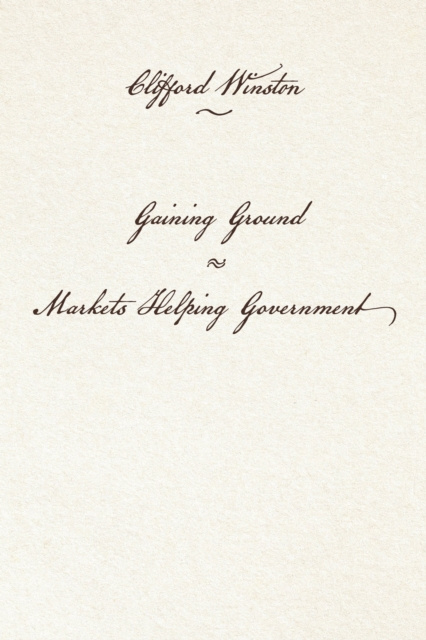
Focusing on ways that markets work with, rather than against, governments to enhance public welfare.The optimal mix of market forces and government intervention to allocate resources is one of the longest-standing problems facing human civilization. At the theoretical extremes, resources in centrally planned economies are allocated by the government, while resources in capitalist economies are allocated by private markets. In practice, market forces and government interventions co-exist to allocate goods and services in a political environment with shifting pressures to give one approach more responsibility than the other.Current public attitudes toward markets are at a low point in the wake of the Great Recession and the growth in income inequality that began in the 1970s. However, in this book, noted Brookings economist Clifford Winston argues that it is a serious mistake to overlook that markets will be a critical part of the solution to any public objectivewhether it be to reduce inequality, stimulate long-term growth, slow climate change, or eliminate COVID 19. In Winston's view, policymakers should be much more aware of the many ways that markets help government to achieve economic and social goals and the potential that markets have to provide greater assistance in achieving those goals.Winston synthesizes the empirical evidence on the efficacy of markets in helping to protect consumers against anti-competitive behavior and when technology appears to prevent price competition; to enable individuals to make more informed decisions; and to reduce negative externalities, improve public production, and encourage innovations. Importantly, Winston presents evidence indicating how markets can also help to reduce poverty, promote fairness in labor markets, and provide merit goods. Winston subjects his assessment to a robustness test by explaining how market forces have helped to address the COVID-19 pandemic by, for example, finding new ways for people to work safely and providing incentives for pharmaceutical companies to develop safe and effective vaccines.Winston takes a proactive approach in his conclusion by suggesting the formation of a major Commission composed of academics, policymakers, and businesspeople. Such a panel could explore how market forces could provide greater help to government to address economic and social problems and could provide specific recommendations to facilitate market solutions where appropriate.


Sobre el libro
Inglés
Categorías

Regale este libro hoy
Es fácil
1 Añadir al carrito y elegir Entregar como regalo en el checkout 2 Le enviaremos un vale 3 El libro llegará a la dirección del destinatarioTambién puede interesarle









 /
Tapa blanda
6.99
€
/
Tapa blanda
6.99
€
 /
Tapa blanda
8.79
€
/
Tapa blanda
8.79
€





¡Hola! Soy Libroamiko, tu asesor de libros.
¿Cómo puedo ayudarte?