
 Contacto
 Cómo comprar
Entrega
Guía de compras
 Inglés
 266 b
266 b
Política de devolución de 30 días
Clientes que también han comprado



 /
/
 Tapa dura
 14.29
€
14.29
€








 /
Tapa blanda
27.69
€
/
Tapa blanda
27.69
€
 /
Tapa blanda
27.69
€
/
Tapa blanda
27.69
€

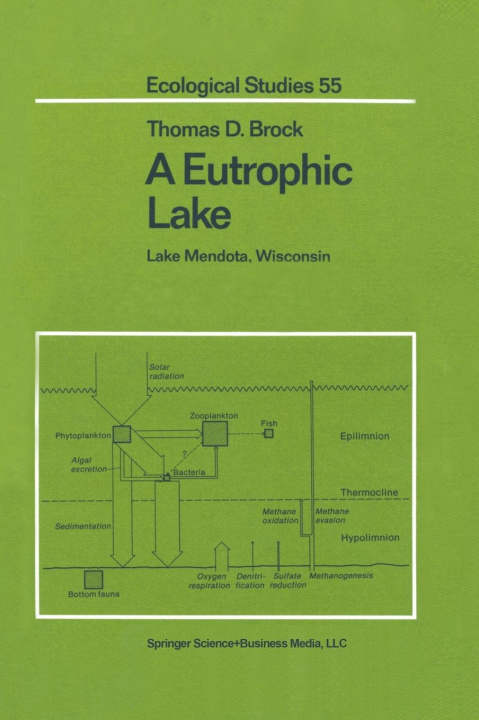
1. Introduction.- The origin of the lake.- The naming of the Madison lakes.- Ownership of Lake Mendota.- The regional setting.- 2. Physical Limnology.- Morphometry and Hydrography.- General Features of the Lake.- Hypsometry of Lake Mendota.- Climate of the Lake Mendota area.- Water budget of the lake.- Thermal structure and heat budget.- Water movement.- Summary. The four seasons in Lake Mendota.- 3. Chemistry and nutrient loading.- Chemistry of the lake water.- Nutrient loading studies.- Sediment composition and chemistry.- Recent sediments in Lake Mendota.- Oxygen in Lake Mendota.- Nitrogen in Lake Mendota.- Phosphorus in Lake Mendota.- Iron and manganese.- Sulfate.- Chloride.- Silica.- Inorganic carbon in Lake Mendota.- Summary.- 4. Phytoplankton.- Methodology for studying phytoplankton populations in Lake Mendota.- Annual cycles of phytoplankton.- Mean depth of chlorophyll.- Surface/volume ratios of phytoplankton cells.- Diatom blooms in Lake Mendota.- Blue-green algae of Lake Mendota.- Buoyancy of the blue-green algae of Lake Mendota.- Where do the algae go?.- Summary.- 5. Phytoplankton photosynthesis and primary production.- Methods.- Calculating whole lake productivity from incubator data.- Photosynthesis/light (P/I) relationship.- Photosynthetic efficiency of Lake Mendota phytoplankton 125.- Primary production in Lake Mendota.- A model for Lake Mendota production.- 6. Zooplankton.- Methods for studying Lake Mendota Zooplankton.- Species composition.- Zooplankton abundance.- Biomass of Zooplankton.- Conclusions.- 7. Bacteria, carbon cycling, and biogeochemical processes.- Methods.- Bacterial biomass and production in the water column.- The impact of Zooplankton feeding on bacteria.- Importance of bacterial attachment to particles.- A model for bacterioplankton growth and disappearance.- Significance of algal excretory products for epilimnetic bacteria.- Bacterial processes in the anaerobic deep-water sediments.- Sulfate reduction in Lake Mendota.- Conclusion.- 8. Higher Trophic Levels.- Bottom fauna.- Fish.- Summary.- 9. Long-term Change in Lake Mendota.- Chemistry and nutrient loading.- Oxygen in Lake Mendota.- Secchi transparency.- Phytoplankton.- Zooplankton.- Bacteria.- Fish.- Conclusion.- 10. Energy flow in the Lake Mendota ecosystem.- Appendix 1. Physical and chemical data.- Appendix 2. Phytoplankton data.


Sobre el libro
Inglés

Regale este libro hoy
Es fácil
1 Añadir al carrito y elegir Entregar como regalo en el checkout 2 Le enviaremos un vale 3 El libro llegará a la dirección del destinatarioTambién puede interesarle
 /
Tapa dura
132.69
€
/
Tapa dura
132.69
€


 /
/
 Adobe ePub DRM
13.79
€
Adobe ePub DRM
13.79
€






 /
Tapa blanda
39.69
€
/
Tapa blanda
39.69
€





 /
Tapa blanda
28.59
€
/
Tapa blanda
28.59
€




¡Hola! Soy Libroamiko, tu asesor de libros.
¿Cómo puedo ayudarte?