
 Contacto
 Cómo comprar
Entrega
Guía de compras
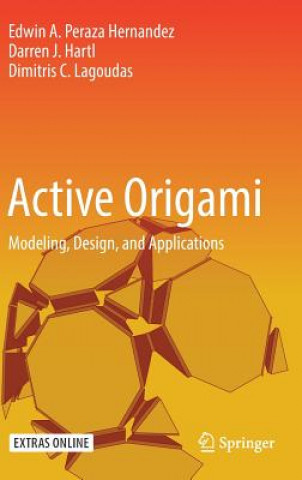
Active Origami
Modeling, Design, and Applications
 Inglés
 573 b
573 b
Política de devolución de 30 días
Clientes que también han comprado





Over the past decades, there has been an increasing interest in the exploration and application of theoretical and computational origami. The ability of origami designs to be easily fabricated in two dimensions, to enable deployment of large structures from small initial volumes, and to be reconfigurable has captured the attention of engineers from across the world. In this book, the three pillars of solid mechanics (conservation laws, constitutive modeling, and most especially kinematics) are combined with structural design approaches to present a full theory for origami structures. The focus is on the folding of engineering materials, including those having strain limitations and formed into sheets of finite thickness. The book begins with a review of recent applications and theoretical developments of origami with active materials. To provide a starting point for the new developments presented in the book, kinematic modeling and design of conventional origami forms with creased folds are initially addressed. Subsequently, a kinematic theory for the strain sensitive (smooth) folding of engineering materials is presented. Design methods for creating three-dimensional forms from two-dimensional sheets having smooth folds are then derived. Afterwards, the model for the structural mechanics of origami sheets with smooth folds, which is applicable to structures comprised of arbitrary materials (e.g., elastic materials, active materials), is presented. Finally, frameworks for the design of active material-based origami structures that morph towards goal shapes under the application of non-mechanical stimuli are presented. Throughout the book, the reader is provided with development examples and problems. The supplemental materials include the implementation codes of the derived theories. The detailed derivations and implementation examples make this an ideal book for advanced students as well as engineers who aim to use origami principles on applications in their field.


Sobre el libro
Inglés

Regale este libro hoy
Es fácil
1 Añadir al carrito y elegir Entregar como regalo en el checkout 2 Le enviaremos un vale 3 El libro llegará a la dirección del destinatarioTambién puede interesarle
 /
/
 Tapa dura
 270.69
€
270.69
€






 /
Tapa blanda
13.59
€
/
Tapa blanda
13.59
€
 /
Tapa blanda
27.69
€
/
Tapa blanda
27.69
€
 /
Tapa dura
32.79
€
/
Tapa dura
32.79
€


¡Hola! Soy Libroamiko, tu asesor de libros.
¿Cómo puedo ayudarte?