
 Contacto
 Cómo comprar
Entrega
Guía de compras
 Inglés
 624 b
624 b
Política de devolución de 30 días
Clientes que también han comprado









 /
/
 Tapa dura
 7.39
€
7.39
€






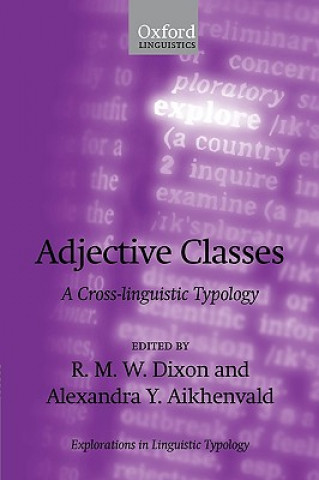
This book shows that every language has an adjective class and examines how these vary in size and character. The opening chapter considers current generalizations about the nature and classification of adjectives and sets out the cross-linguistic parameters of their variation. Thirteen chapters then explore adjective classes in languages from North, Central and South America, Europe, Africa, Asia, and the Pacific. Studies of well-known languages such as Russian, Japanese, Korean and Lao are juxtaposed with the languages of small hunter-gatherer and slash-and-burn agriculturalist groups. All are based on fine-grained field research. The nature and typology of adjective classes are then reconsidered in the conclusion. This pioneering work shows, among other things, that the grammatical properties of the adjective class may be similar to nouns or verbs or both or neither; that some languages have two kinds of adjectives, one hard to distinguish from nouns and the other from verbs; that the adjective class can sometimes be large and open, and in other cases small and closed. The book will interest scholars and advanced students of language typology and of the syntax and semantics of adjectives. Each book in this series focuses on an aspect of language that is of current theoretical interest and for which there has not previously or recently been any full-scale cross-linguistic study. The series is for typologists, fieldworkers, and theory developers at graduate level and above. The books will be suited for use as the basis for advanced seminars and courses. The subjects of next three volumes will be serial verb constructions, complementation, and grammars in contact.


Sobre el libro
Inglés

Regale este libro hoy
Es fácil
1 Añadir al carrito y elegir Entregar como regalo en el checkout 2 Le enviaremos un vale 3 El libro llegará a la dirección del destinatarioTambién puede interesarle



 /
Tapa blanda
14.99
€
/
Tapa blanda
14.99
€


 /
Tapa blanda
13.79
€
/
Tapa blanda
13.79
€

 /
Tapa blanda
8.49
€
/
Tapa blanda
8.49
€
 /
Tapa dura
54.39
€
/
Tapa dura
54.39
€






 /
Tapa blanda
16.49
€
/
Tapa blanda
16.49
€
 /
Tapa blanda
50.79
€
/
Tapa blanda
50.79
€





¡Hola! Soy Libroamiko, tu asesor de libros.
¿Cómo puedo ayudarte?