Contacto
 Cómo comprar
Entrega
Guía de compras
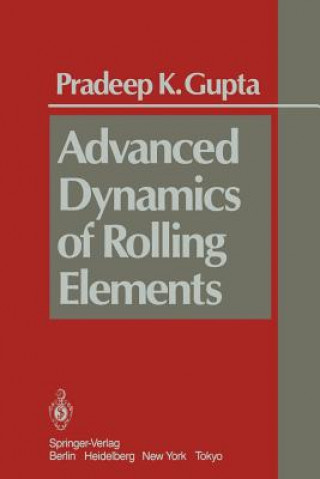
Advanced Dynamics of Rolling Elements
 Inglés
 276 b
276 b
Hasta 30 días para devoluciones
Clientes que también han comprado


 /
/
 Tapa blanda
 17.89
€
17.89
€

 /
Tapa blanda
10.59
€
/
Tapa blanda
10.59
€





 /
Tapa blanda
26.69
€
/
Tapa blanda
26.69
€













 /
Tapa blanda
67.89
€
/
Tapa blanda
67.89
€
 /
Tapa blanda
73.99
€
/
Tapa blanda
73.99
€


 /
Tapa blanda
16.09
€
/
Tapa blanda
16.09
€
 /
Tapa dura
36.39
€
/
Tapa dura
36.39
€


In any rotating machinery system, the bearing has traditionally been a crit ical member of the entire system, since it is the component that permits the relative motion between the stationary and moving parts. Depending on the application, a number of different bearing types have been used, such as oil-lubricated hydrodynamic bearings, gas bearings, magnetic suspensions, rolling element bearings, etc. Hydrodynamic bearings can provide any desired load support, but they are limited in stiffness and the associated power loss may be quite large. Gas bearings are used for high-precision applications where the supported loads are relatively light, bearing power losses are very low, and the rotating speeds generally high. For super precision components where no frictional dissipation or bearing power loss can be tolerated, magnetic suspensions are employed; again, the load support requirements are very low. Rolling element bearings have been widely used for those applications that require greater bearing versatility, due to the requirements for high-load and high-stiffness characteristics, while allowing moderate power loss and permitting variable speeds. A study of the dynamic interaction of rolling elements is, therefore, the subject of this text. Texts covering the analysis and design methodology of rolling elements are very limited. Notable works include Analysis of Stresses and Deflections (Jones, 1946, Vols. I and II), Ball and Roller Bearings, Their Theory, Design and Application (Eschmann, Hasbargen, and Weigand, 1958), Ball and Roller Bearing Engineering (Palmgren, 1959, 3rd ed. ), Advanced Bearing Technology (Bisson and Anderson, 1965), and Rolling Bearing Analysis (Harris, 1966).


Sobre el libro
Inglés
Categorías

Regale este libro hoy
Es fácil
1 Añadir al carrito y elegir Entregar como regalo en el checkout 2 Le enviaremos un vale 3 El libro llegará a la dirección del destinatarioTambién puede interesarle




 /
Tapa dura
44.59
€
/
Tapa dura
44.59
€










 /
Tapa blanda
16.39
€
/
Tapa blanda
16.39
€
 /
Tapa dura
35.79
€
/
Tapa dura
35.79
€



 /
Tapa blanda
194.09
€
/
Tapa blanda
194.09
€