Contacto
 Cómo comprar
Entrega
Guía de compras
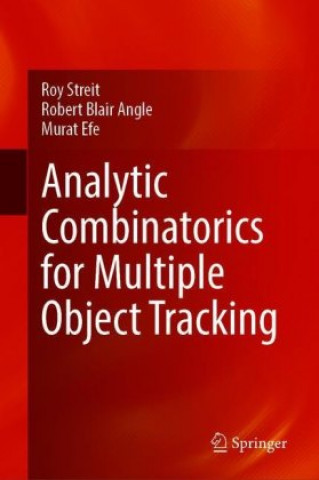
Analytic Combinatorics for Multiple Object Tracking
 Inglés
 359 b
359 b
Política de devolución de 30 días
Clientes que también han comprado



 /
/
 Tapa blanda
 73.09
€
73.09
€

 /
Tapa blanda
39.39
€
/
Tapa blanda
39.39
€










 /
Tapa dura
11.19
€
/
Tapa dura
11.19
€







 /
Tapa blanda
23.29
€
/
Tapa blanda
23.29
€






 /
Tapa blanda
17.89
€
/
Tapa blanda
17.89
€

The book shows that the analytic combinatorics (AC) method encodes the combinatorial problems of multiple object tracking-without information loss-into the derivatives of a generating function (GF). The book lays out an easy-to-follow path from theory to practice and includes salient AC application examples. Since GFs are not widely utilized amongst the tracking community, the book takes the reader from the basics of the subject to applications of theory starting from the simplest problem of single object tracking, and advancing chapter by chapter to more challenging multi-object tracking problems. Many established tracking filters (e.g., Bayes-Markov, PDA, JPDA, IPDA, JIPDA, CPHD, PHD, multi-Bernoulli, MBM, LMBM, and MHT) are derived in this manner with simplicity, economy, and considerable clarity. The AC method gives significant and fresh insights into the modeling assumptions of these filters and, thereby, also shows the potential utility of various approximation methods that are well established techniques in applied mathematics and physics, but are new to tracking. These unexplored possibilities are reviewed in the final chapter of the book.


Sobre el libro
Inglés

Regale este libro hoy
Es fácil
1 Añadir al carrito y elegir Entregar como regalo en el checkout 2 Le enviaremos un vale 3 El libro llegará a la dirección del destinatarioTambién puede interesarle





 /
Tapa blanda
11.79
€
/
Tapa blanda
11.79
€











 /
Tapa dura
40.29
€
/
Tapa dura
40.29
€