
 Contacto
 Cómo comprar
Entrega
Guía de compras
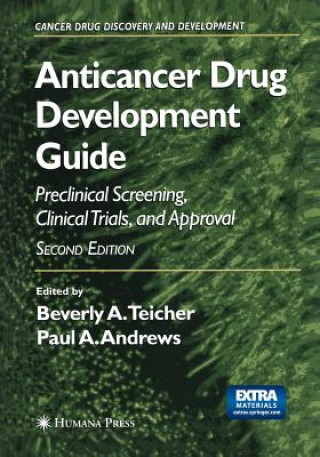
Anticancer Drug Development Guide
Preclinical Screening, Clinical Trials, and Approval
 Inglés
 406 b
406 b
Política de devolución de 30 días
Clientes que también han comprado









This unique volume traces the critically important pathway by which a "molecule" becomes an "anticancer agent. " The recognition following World War I that the administration of toxic chemicals such as nitrogen mustards in a controlled manner could shrink malignant tumor masses for relatively substantial periods of time gave great impetus to the search for molecules that would be lethal to specific cancer cells. Weare still actively engaged in that search today. The question is how to discover these "anticancer" molecules. Anticancer Drug Development Guide: Preclinical Screening, Clinical Trials, and Approval, Second Edition describes the evolution to the present of preclinical screening methods. The National Cancer Institute's high-throughput, in vitro disease-specific screen with 60 or more human tumor cell lines is used to search for molecules with novel mechanisms of action or activity against specific phenotypes. The Human Tumor Colony-Forming Assay (HTCA) uses fresh tumor biopsies as sources of cells that more nearly resemble the human disease. There is no doubt that the greatest successes of traditional chemotherapy have been in the leukemias and lymphomas. Since the earliest widely used in vivo drug screening models were the murine L 1210 and P388 leukemias, the community came to assume that these murine tumor models were appropriate to the discovery of "antileukemia" agents, but that other tumor models would be needed to discover drugs active against solid tumors.


Sobre el libro
Inglés

Regale este libro hoy
Es fácil
1 Añadir al carrito y elegir Entregar como regalo en el checkout 2 Le enviaremos un vale 3 El libro llegará a la dirección del destinatarioTambién puede interesarle
 /
/
 Tapa blanda
 15.39
€
15.39
€
















¡Hola! Soy Libroamiko, tu asesor de libros.
¿Cómo puedo ayudarte?