Contacto
 Cómo comprar
Entrega
Guía de compras
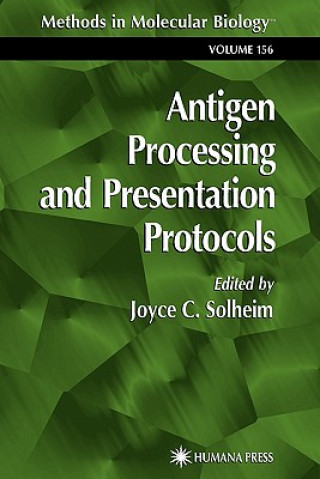
Antigen Processing and Presentation Protocols
 Inglés
 290 b
290 b
Política de devolución de 30 días
Clientes que también han comprado


 /
/
 Tapa blanda
 24.79
€
24.79
€






 /
Tapa blanda
22.49
€
/
Tapa blanda
22.49
€







 /
Tapa blanda
48.29
€
/
Tapa blanda
48.29
€

Well-recognized and innovative experimentalists detail their cutting-edge methods for studying the antigen processing and presentation. Drawing on expertise from biochemistry, cell biology, and immunology, they describe step-by-step methods designed to question how MHC-binding peptides are generated, to test how peptides are delivered to MHC molecules, to analyze MHC peptide-binding patterns, and to assay the T-cell response to the MHC/peptide complex. Emphasis is given those technical steps critical for experimental success that are often omitted from methods published in the primary literature. Eminently accessible and state-of-the-art, Antigen Processing and Presentation Protocols provides both new and experienced investigators with highly practical tools that will extend the questions that can be asked, and effectively be answered, concerning antigen processing/presentation.The processing and presentation of antigens by major histocompatibility complex (MHC) molecules is a crucial immunological phenomenon in infectious disease, malignancy, autoimmune disease, and transplantation. In Antigen Processing and Presentation Protocols, well-recognized and innovative experimentalists detail their cutting-edge methods for studying this complex process. Drawing on expertise from biochemistry, cell biology, and immunology, they describe step-by-step methods designed to question how MHC-binding peptides are generated, to test how peptides are delivered to MHC molecules, to analyze MHC peptide-binding patterns, and to assay the T cell response to the MHC/peptide complex. Each method is presented in sufficient detail to be readily reproducible and includes notes about potential pitfalls and tips on how to avoid failures. Emphasis is given those technical steps critical for experimental success that are often omitted from methods published in the primary literature.§Eminently accessible and state-of-the-art, Antigen Processing and Presentation Protocols provides both new and experienced investigators with highly practical tools that will extend the questions that can be asked, and effectively be answered, concerning antigen processing/presentation.


Sobre el libro
Inglés

Regale este libro hoy
Es fácil
1 Añadir al carrito y elegir Entregar como regalo en el checkout 2 Le enviaremos un vale 3 El libro llegará a la dirección del destinatarioTambién puede interesarle




















 /
Tapa blanda
103.09
€
/
Tapa blanda
103.09
€