Contacto
 Cómo comprar
Entrega
Guía de compras
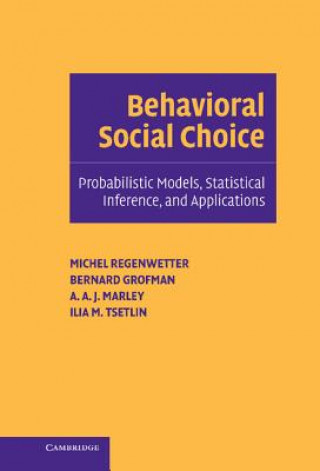
Behavioral Social Choice
Probabilistic Models, Statistical Inference, and Applications
 Inglés
 270 b
270 b
Hasta 30 días para devoluciones
Clientes que también han comprado

















Behavioral Social Choice looks at the probabilistic foundations of collective decision-making rules. The authors challenge much of the existing theoretical wisdom about social choice processes, and seek to restore faith in the possibility of democratic decision-making. In particular, they argue that worries about the supposed prevalence of majority rule cycles that would preclude groups from reaching a final decision about what alternative they prefer have been greatly overstated. In practice, majority rule can be expected to work well in most real-world settings. Furthermore, if there is a problem, they show that the problem is more likely to be one of sample estimates missing the majority winner in a close contest (e.g., Bush-Gore) than a problem about cycling. The authors also provide new mathematical tools to estimate the prevalence of cycles as a function of sample size and insights into how alternative model specifications can change our estimates of social orderings.


Sobre el libro
Inglés
Categorías

Regale este libro hoy
Es fácil
1 Añadir al carrito y elegir Entregar como regalo en el checkout 2 Le enviaremos un vale 3 El libro llegará a la dirección del destinatarioTambién puede interesarle










 /
/
 Tapa dura
 139.29
€
139.29
€

 /
Tapa blanda
18.89
€
/
Tapa blanda
18.89
€










 /
Tapa blanda
69.09
€
/
Tapa blanda
69.09
€