
 Contacto
 Cómo comprar
Entrega
Guía de compras
 Inglés
 28 b
28 b
 Próximamente
 Nuevo
Nuevo
Hasta 30 días para devoluciones

Do human beings exist in order to survive? Really?
I want to explain one fundamental reason why human society remains so deeply unhappy.
For roughly the past 150 years, a powerful interpretation of evolution has spread far beyond biology. Competition, selection, elimination, and "survival of the fittest" came to be treated not merely as biological mechanisms, but as a general description of life itself.
The problem is not Darwin's theory of evolution. Natural selection is an important mechanism of modern biology. The problem begins when a biological principle is transformed into a philosophy of human existence and extended into education, economics, politics, institutions, and everyday life.
This misreading did not create cruelty. Competition, domination, warfare, and exclusion existed long before Darwin. But evolutionary language sometimes gave them an apparently scientific legitimacy, making inequality, struggle, and exclusion seem natural, inevitable, or even necessary.
We learned to imagine society as one enormous struggle for survival: to survive, we must win; to win, we must stay ahead; and those who fall behind will naturally be excluded. Even as societies became wealthier, this logic became embedded more deeply in schools, corporations, states, and technologies.
Human societies have repeatedly tried to move beyond competition, ranking, and exclusion. Yet such efforts are often undermined by a deeper assumption: that Darwinian selection reveals the fundamental logic of life itself. Societies may reject destructive competition morally while continuing to reproduce it structurally.
Artificial intelligence makes this problem more urgent. AI amplifies, at enormous scale and speed, the objectives we give it and the patterns contained in human data. If it is embedded in institutions where competition, efficiency, ranking, and winner-take-all outcomes are treated as defaults, AI may become an extraordinarily powerful amplifier of those values.
What we need, alongside better technology, is a deeper philosophy grounded in life itself.
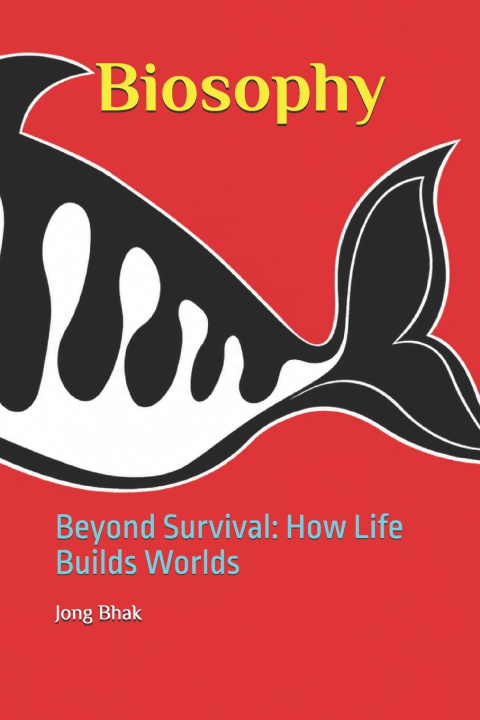
This book calls that philosophy Biosophy.
Biosophy challenges the assumption that life is fundamentally a contest in which organisms face fixed conditions and are sorted according to how successfully they fit them.
Survival is not the purpose of life. Survival is a condition that allows living activity to continue.
Life is a process, not a thing. Living beings sense, regulate, predict, repair, act, and alter the conditions under which they subsequently live.
Humans are the most dramatic example. We created fire and language, agriculture and cities, science and law, institutions and civilizations. Now we are creating artificial intelligence.
Humans do not merely adapt to a given playing field.
We change the playing field itself.
This book calls that process Covolution, or 조화 (造和). It does not simply mean peaceful harmony. 造 means to build, while 和 means to make differentiated parts workable together. Covolution is the construction of relations and conditions through which oneself, other beings, and the shared Symvironment can continue to develop.
A Covolver does not merely fit the playing field. A Covolver participates in building it.
We survive because we sense, build, regulate, connect, repair, and reconstruct the conditions under which life can continue.
This book is about humans and AI beyond the survival-of-the-fittest worldview.


Sobre el libro
Inglés

Regale este libro hoy
Es fácil
1 Añadir al carrito y elegir Entregar como regalo en el checkout 2 Le enviaremos un vale 3 El libro llegará a la dirección del destinatario¡Hola! Soy Libroamiko, tu asesor de libros.
¿Cómo puedo ayudarte?