
 Contacto
 Cómo comprar
Entrega
Guía de compras
 Inglés
 414 b
414 b
Hasta 30 días para devoluciones
Clientes que también han comprado






















 /
/
 Tapa blanda
 37.39
€
37.39
€








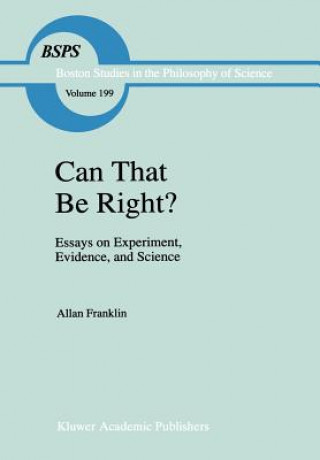
In this collection of essays Allan Franklin defends the view that science provides us with knowledge about the world which is based on experimental evidence and on reasoned and critical discussion. In short, he argues that science is a reasonable enterprise. He begins with detailed studies of four episodes from the history of modern physics: (1) the early attempts to detect gravity waves, (2) how the physics community decided that a proposed new elementary particle, 17-keV neutrino, did not exist, (3) a sequence of experiments on K meson decay, and (4) the origins of the Fifth Force hypothesis, a proposed modification of Newton's Law of Universal Gravitation. The case studies are then used to examine issues such as how discord between experimental results is resolved, calibration of an experimental apparatus and its legitimate use in validating an experimental result, and how experimental results provide reasonable grounds for belief in both the truth of physical theories and in the existence of the entities involved in those theories. This book is a challenge to the critics of science, both postmodern and constructivist, to provide convincing alternative explanations of the episodes and issues discussed. It should be of interest to philosophers, historians, and sociologists of science, and to scientists themselves.


Sobre el libro
Inglés

Regale este libro hoy
Es fácil
1 Añadir al carrito y elegir Entregar como regalo en el checkout 2 Le enviaremos un vale 3 El libro llegará a la dirección del destinatarioTambién puede interesarle
 /
Tapa blanda
118.39
€
/
Tapa blanda
118.39
€

 /
Tapa dura
118.39
€
/
Tapa dura
118.39
€




 /
Tapa blanda
22.89
€
/
Tapa blanda
22.89
€


 /
Tapa blanda
28.79
€
/
Tapa blanda
28.79
€


 /
Tapa blanda
21.59
€
/
Tapa blanda
21.59
€









¡Hola! Soy Libroamiko, tu asesor de libros.
¿Cómo puedo ayudarte?