
 Contacto
 Cómo comprar
Entrega
Guía de compras
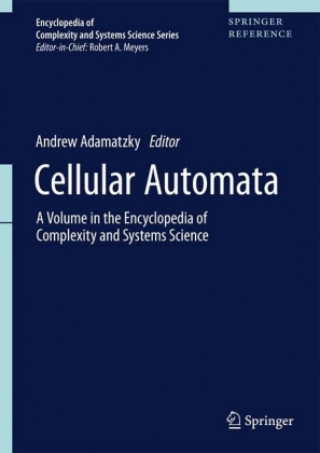
Cellular Automata
 Inglés
 2204 b
Hasta 30 días para devoluciones
Clientes que también han comprado

 /
/
 Tapa blanda
 20.69
€
20.69
€


 /
Tapa blanda
70.00
€
/
Tapa blanda
70.00
€







 /
Tapa blanda
39.09
€
/
Tapa blanda
39.09
€

 /
Tapa blanda
59.19
€
/
Tapa blanda
59.19
€

 /
Tapa blanda
65.69
€
/
Tapa blanda
65.69
€



This volume of the Encyclopedia of Complexity and Systems Science, Second Edition , provides an authoritative introduction and overview of the latest research in cellular automata (CA) models of physical systems, emergent phenomena, computational universality, chaos, growth phenomena, phase transitions, self-organised criticality, reaction-diffusion systems, self-replications, parallel computation, and more. Fundamental topics of algorithmic complexity, algebraic groups, language theory, evolving CA, ergodic theory, synchronisation, tiling problems and undecidability and topological dynamics of CA are addressed. Cellular automata are regular uniform networks of locally-connected finite-state machines, and represent discrete systems with non-trivial behavior, including waves, patterns and travelling localisations. CA are ubiquitous: they are mathematical models of computation and computer models of natural systems. Classes of CA presented in this book include additive CA, automata in hyperbolic spaces and non-compact spaces, CA in triangular, pentagonal and hexagonal tessellations, automata with memory, quantum and reversible automata, structurally-dynamic CA, and asynchronous automata. Topics added to the second edition include: asynchronous cellular automata, stochastic cellular automata as models of reaction-diffusion processes, cellular automata hardware implementation, cellular automata basins of attraction, orbits of Bernoulli measures in cellular automata, and graphs related to reversibility and complexity in cellular. This state-of-the-art reference is unique in bringing together unequalled expertise of interdisciplinary studies at the edge of mathematics, computer science, and physics.


Sobre el libro
Inglés

Regale este libro hoy
Es fácil
1 Añadir al carrito y elegir Entregar como regalo en el checkout 2 Le enviaremos un vale 3 El libro llegará a la dirección del destinatarioTambién puede interesarle



 /
Tapa blanda
12.49
€
/
Tapa blanda
12.49
€




 /
Tapa blanda
28.19
€
/
Tapa blanda
28.19
€






 /
Tapa blanda
15.79
€
/
Tapa blanda
15.79
€
 /
Tapa blanda
49.49
€
/
Tapa blanda
49.49
€









¡Hola! Soy Libroamiko, tu asesor de libros.
¿Cómo puedo ayudarte?