
 Contacto
 Cómo comprar
Entrega
Guía de compras
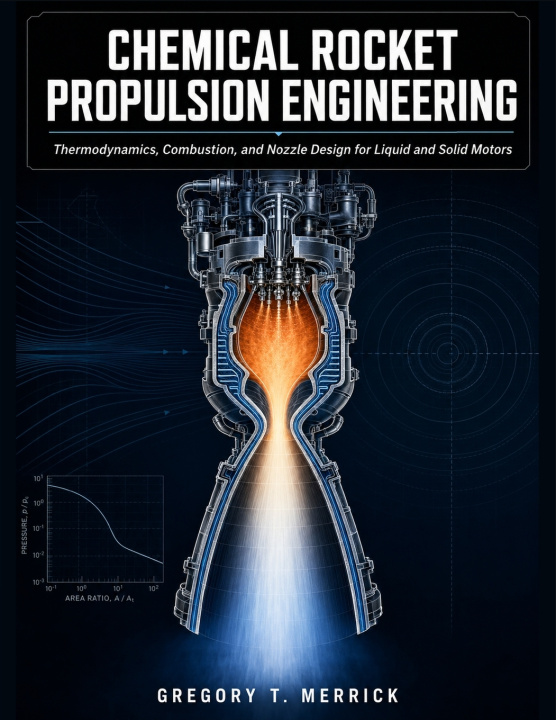
CHEMICAL ROCKET PROPULSION ENGINEERING
Thermodynamics, Combustion, and Nozzle Design for Liquid and Solid Motors
 Inglés
 232 b
232 b
 Próximamente
 Nuevo
Nuevo
Hasta 30 días para devoluciones

Many engineering graduates can state that specific impulse equals thrust divided by propellant weight flow, yet cannot explain why a hydrogen engine and a kerosene engine at the same chamber pressure differ by roughly ninety seconds. The equations are seldom the obstacle; the missing piece is the chain of physical reasoning that connects them.
Rocket propulsion is often taught as a set of formulas delivered without their reasoning. Performance is presented as an ideal number rather than a starting point, so the gap between a textbook prediction and a real engine on a test stand goes unexplained - and an engineer is left able to compute a value but unable to locate the source of a shortfall.
This comprehensive guide rebuilds the subject as a connected argument. It organises engine performance around a single decomposition - how good is the combustion, and how good is the nozzle - so that every later topic has a known place to attach. Ideal performance is treated as the beginning of the analysis, and the book shows how to account honestly for the losses that separate theory from delivered thrust, all the way to a fully worked integrated design example.
Inside, you will:
• See how the core performance parameters separate a combustion question from a nozzle question, and use that split to locate a shortfall.
• Follow fully worked examples with every intermediate value shown and units tracked through the algebra.
• Size a thrust chamber, choose a chamber pressure, and select an engine cycle by tracing the couplings among feed system, cooling, and injector.
• Compare propellant combinations, analyse regenerative and film cooling, and recognise when a design reaches its limit.
• Interpret a static test, correct measured thrust, and account for uncertainty.
• Apply the same reasoning across liquid engines, solid motors, and hybrid systems.
Key topics include the thrust equation and performance parameters; mission velocity budgets and staging; propellant thermochemistry and combustion equilibrium; compressible flow and the ideal rocket; nozzle contours, expansion losses, and altitude compensation; thrust chamber sizing, cooling, and structure; injectors, mixing, and combustion stability; engine cycles, feed systems, and turbopumps; solid motor internal ballistics and grain design; hybrid systems; and testing, instrumentation, and performance accounting.
It is written for upper-level undergraduate and beginning graduate students in aerospace and mechanical engineering, and for practising engineers who want a dependable working reference. The book assumes a background in engineering thermodynamics, compressible flow, introductory heat transfer, and mechanics of materials.
Begin building the chain of reasoning that turns propulsion formulas into engineering judgement - open this comprehensive guide and start connecting theory to the hardware it is meant to describe.


Sobre el libro
Inglés

Regale este libro hoy
Es fácil
1 Añadir al carrito y elegir Entregar como regalo en el checkout 2 Le enviaremos un vale 3 El libro llegará a la dirección del destinatario¡Hola! Soy Libroamiko, tu asesor de libros.
¿Cómo puedo ayudarte?