
 Contacto
 Cómo comprar
Entrega
Guía de compras
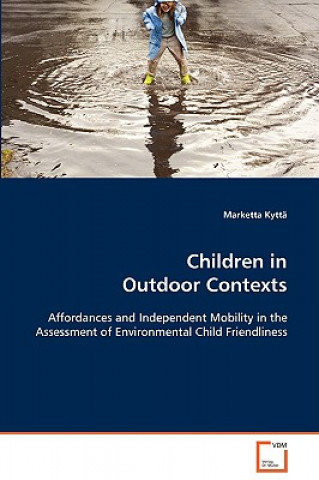
Children in Outdoor Contexts
Affordances and Independent Mobility in theAssessment of Environmental Child Friendliness
 Inglés
 208 b
208 b
Hasta 30 días para devoluciones
Clientes que también han comprado



Environmental psychology concerning child-environment§relationships has too often forgotten the environment§itself. Place based child-environment research is§needed to anchor children s experiences and behaviour§to actual physical settings. This book introduces a§new assessment model for a child-friendly§environment, based on two central criteria:§children's possibilities for independent mobility and§their opportunities to actualize environmental§affordances. Four hypothetical types of environment§are distinguished: Bullerby, Wasteland, Cell, and§Glasshouse. The Bullerby represents a child-friendly§environment, as it allows a positive interactive§cycle to develop between a child and the environment.§The empirical results from almost 250 children§indicate that the model is sensitive enough to assess§the child friendliness of different communities in§Finland and Belarus. In general, the proportion of§Bullerby settings decreases and that of Glasshouse§settings increases as the degree of urbanization§rises. The Bullerby-model allows the integration of§children's experiences with the material world, and§it provides information that can be used in planning§of child-friendly environments. Environmental psychology concerning child-environment§relationships has too often forgotten the environment§itself. Place based child-environment research is§needed to anchor children s experiences and behaviour§to actual physical settings. This book introduces a§new assessment model for a child-friendly§environment, based on two central criteria:§children''s possibilities for independent mobility and§their opportunities to actualize environmental§affordances. Four hypothetical types of environment§are distinguished: Bullerby, Wasteland, Cell, and§Glasshouse. The Bullerby represents a child-friendly§environment, as it allows a positive interactive§cycle to develop between a child and the environment.§The empirical results from almost 250 children§indicate that the model is sensitive enough to assess§the child friendliness of different communities in§Finland and Belarus. In general, the proportion of§Bullerby settings decreases and that of Glasshouse§settings increases as the degree of urbanization§rises. The Bullerby-model allows the integration of§children''s experiences with the material world, and§it provides information that can be used in planning§of child-friendly environments.


Sobre el libro
Inglés
Categorías

Regale este libro hoy
Es fácil
1 Añadir al carrito y elegir Entregar como regalo en el checkout 2 Le enviaremos un vale 3 El libro llegará a la dirección del destinatarioTambién puede interesarle











¡Hola! Soy Libroamiko, tu asesor de libros.
¿Cómo puedo ayudarte?