
 Contacto
 Cómo comprar
Entrega
Guía de compras
Chloroplast
Basics and Applications
 Inglés
 552 b
552 b
Política de devolución de 30 días
Clientes que también han comprado










 /
/
 Tapa blanda
 55.09
€
55.09
€





 /
Tapa blanda
43.49
€
/
Tapa blanda
43.49
€



 /
Tapa blanda
58.09
€
/
Tapa blanda
58.09
€






 /
Tapa blanda
15.29
€
/
Tapa blanda
15.29
€


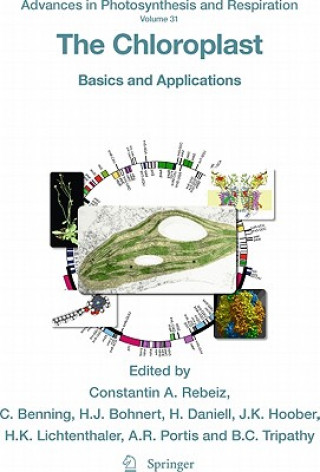
The world population is expected to increase to 9 billion by the year 2050 which will generate food and fuel shortages. Since it will be difficult to increase the land area under cultivation without serious environmental consequences, higher productivity for biomass is required. Improvement in photosynthetic efficiency would require increased knowledge and deeper understanding of :(a) the biosynthesis of photosynthetic membrane components such as hemes, chlorophylls, carotenoids, quinones, and lipids; (b) photosynthetic membrane apoprotein biosynthesis; (c) the biosynthesis and regulation of the assembly of pigment-apoprotein complexes; and (d) the complexities of carbon sensing, biosynthesis and allocation. These goals may be accomplished by bioengineering of chloroplasts with higher photosynthetic efficiency and superior adaptation to various stresses and/or alteration of the kinetic properties of the CO2-assimilating enzyme, Rubisco. Advances towards this goal are addressed in this volume that will foster cooperation between biochemists and molecular biologists, scientists involved in photosynthesis research and biotechnologists involved in plant and plastid genomics and transformation. We envision future research to focus attention on "Chloroplast Bioengineering" as an integrated novel field of research. This book is designed for graduate students and researchers in chlorophyll metabolism, integrative plant biology, plant physiology, plant biochemistry, plant molecular biology, biotechnology, bioenergy and biofuels.


Sobre el libro
Inglés
Categorías

Regale este libro hoy
Es fácil
1 Añadir al carrito y elegir Entregar como regalo en el checkout 2 Le enviaremos un vale 3 El libro llegará a la dirección del destinatarioTambién puede interesarle
 /
Tapa dura
112.79
€
/
Tapa dura
112.79
€



 /
Tapa dura
30.79
€
/
Tapa dura
30.79
€

 /
Tapa blanda
28.79
€
/
Tapa blanda
28.79
€











 /
Tapa dura
215.89
€
/
Tapa dura
215.89
€


 /
Tapa blanda
13.59
€
/
Tapa blanda
13.59
€

 /
Tapa blanda
10.69
€
/
Tapa blanda
10.69
€
¡Hola! Soy Libroamiko, tu asesor de libros.
¿Cómo puedo ayudarte?