
 Contacto
 Cómo comprar
Entrega
Guía de compras
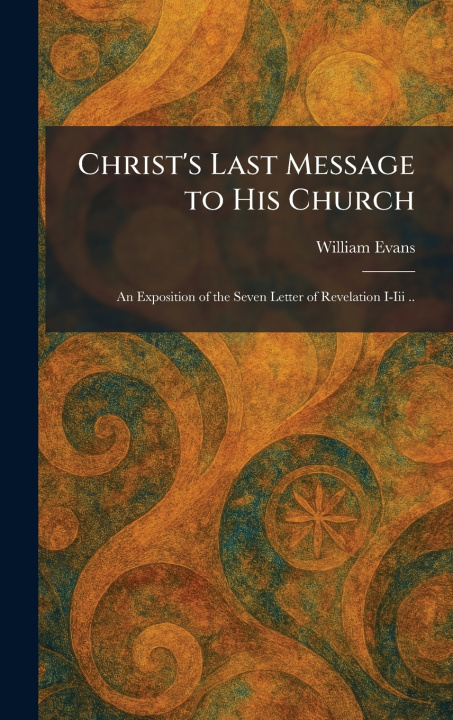
Christ's Last Message to His Church
An Exposition of the Seven Letter of Revelation I-Iii ..
 Inglés
 82 b
82 b
 Nuevo
Nuevo
Política de devolución de 30 días

"Christ's Last Message to His Church" provides a profound and detailed exposition of the opening chapters of the Book of Revelation. Authored by noted Bible teacher William Evans, this work delves into the specific messages addressed to the seven churches of Asia: Ephesus, Smyrna, Pergamum, Thyatira, Sardis, Philadelphia, and Laodicea. Evans explores the spiritual significance of these letters, interpreting the warnings, commendations, and promises offered to each congregation.
By examining the historical context and the eternal theological truths contained within Revelation 1-3, this commentary seeks to illuminate the relevance of Christ's final exhortations for the modern believer. The author provides a verse-by-verse analysis that clarifies difficult passages and emphasizes the practical application of biblical prophecy. "Christ's Last Message to His Church" stands as a vital resource for students of the Bible and laypeople alike who wish to understand the spiritual state of the early church and the enduring call to faithfulness and repentance. Through clear and accessible language, Evans invites readers to consider the profound implications of these divine communications for personal and corporate Christian living.
This work has been selected by scholars as being culturally important, and is part of the knowledge base of civilization as we know it. This work was reproduced from the original artifact, and remains as true to the original work as possible. Therefore, you may see the original copyright references, library stamps (as most of these works have been housed in our most important libraries around the world), and other notations in the work.
This work is in the public domain in the United States of America, and possibly other nations. Within the United States, you may freely copy and distribute this work, as no entity (individual or corporate) has a copyright on the body of the work.
As a reproduction of a historical artifact, this work may contain missing or blurred pages, poor pictures, errant marks, etc. Scholars believe, and we concur, that this work is important enough to be preserved, reproduced, and made generally available to the public. We appreciate your support of the preservation process, and thank you for being an important part of keeping this knowledge alive and relevant.


Sobre el libro
Inglés
