
 Contacto
 Cómo comprar
Entrega
Guía de compras
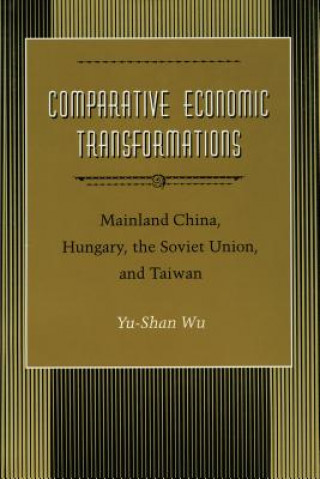
Comparative Economic Transformations
Mainland China, Hungary, the Soviet Union, and Taiwan
 Inglés
 209 b
209 b
Política de devolución de 30 días
Clientes que también han comprado



 /
/
 Tapa blanda
 20.09
€
20.09
€
 /
Tapa dura
32.79
€
/
Tapa dura
32.79
€


 /
Tapa dura
34.29
€
/
Tapa dura
34.29
€


 /
Hoja
23.59
€
/
Hoja
23.59
€

This pathbreaking study illuminates the problems of economic liberalisation in authoritarian, command-economy states. It demonstrates that large structural shifts in economic policy can usefully be viewed in terms of two variables - the degree of state ownership of property, and the degree of state control of that property. Using this property rights framework, the author provides a richly detailed comparison of shifts towards 'market socialism' (state ownership without state control) in the People's Republic of China in the 1980s, the Soviet Union in the 1920s, and Hungary in the 1960s and 70s. He also looks at Taiwan's development of 'state capitalism' (private ownership with state control) in the 1950s and 60s. The book explains what factors prompt an authoritarian regime to launch reforms and, in the process, yields many insights into factors that divert the course of change.


Sobre el libro
Inglés

Regale este libro hoy
Es fácil
1 Añadir al carrito y elegir Entregar como regalo en el checkout 2 Le enviaremos un vale 3 El libro llegará a la dirección del destinatarioTambién puede interesarle




 /
Tapa blanda
8.89
€
/
Tapa blanda
8.89
€
 /
Tapa dura
25.79
€
/
Tapa dura
25.79
€
 /
Tapa dura
32.79
€
/
Tapa dura
32.79
€






 /
Tapa dura
74.09
€
/
Tapa dura
74.09
€
 /
Tapa dura
177.69
€
/
Tapa dura
177.69
€



 /
Tapa dura
663.19
€
/
Tapa dura
663.19
€