
 Contacto
 Cómo comprar
Entrega
Guía de compras
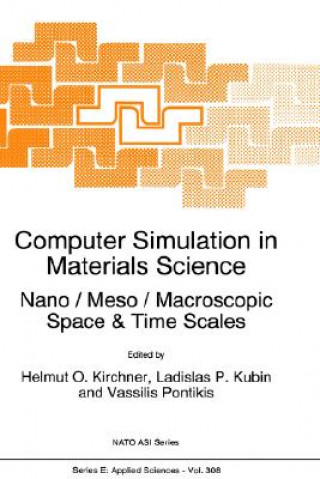
Computer Simulation in Materials Science
Nano/ Meso/ Macroscopic Space & Times Scales
 Inglés
 746 b
746 b
Hasta 30 días para devoluciones
Clientes que también han comprado














 /
/
 Tapa blanda
 17.19
€
17.19
€


 /
Tapa dura
21.29
€
/
Tapa dura
21.29
€

 /
Tapa dura
17.69
€
/
Tapa dura
17.69
€










 /
Tapa blanda
42.39
€
/
Tapa blanda
42.39
€



For decades to come, the limits to computing power will not allow atomistic simulations of macroscopic specimens. Simulations can only be performed on various scales (nano, meso, micro and macro) using the input provided by simulations (or data) on the next smaller scale. The resulting hierarchy has been the focus of many seminars and lectures. Necessarily, special emphasis has been placed on mesoscopic simulations, bridging the gaps between nano (atomic) and micro space and time scales. The contributors to Computer Simulation in Materials Science consider both fundamental problems and applications. Papers on the evolution of morphological patterns in phase transformations and plastic deformation, irradiation effects, mass transport and mechanical properties of materials in general highlight what has already been achieved. It is concluded that computer simulations must be based on realistic and efficient models: the fundamental equations controlling the dynamical evolution of microstructures, stochastic field kinetic models, being a case in point. The mesoscopic approach has proved particularly effective in plastic deformation and work hardening. On the mesoscopic scale, the contributions made to the deformation of polycrystals and localized plastic flow show the importance of computing power in ongoing and future research.


Sobre el libro
Inglés
Categorías

Regale este libro hoy
Es fácil
1 Añadir al carrito y elegir Entregar como regalo en el checkout 2 Le enviaremos un vale 3 El libro llegará a la dirección del destinatarioTambién puede interesarle



 /
Tapa dura
92.99
€
/
Tapa dura
92.99
€



 /
Tapa blanda
18.29
€
/
Tapa blanda
18.29
€



 /
Tapa blanda
7.89
€
/
Tapa blanda
7.89
€











 /
Tapa blanda
42.59
€
/
Tapa blanda
42.59
€

¡Hola! Soy Libroamiko, tu asesor de libros.
¿Cómo puedo ayudarte?