
 Contacto
 Cómo comprar
Entrega
Guía de compras
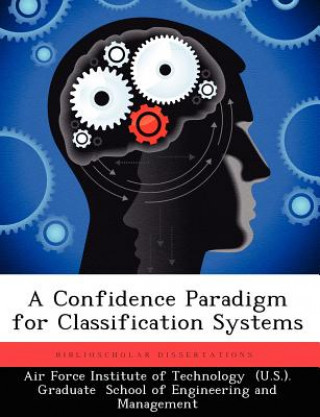
Confidence Paradigm for Classification Systems
 Inglés
 49 b
49 b
Hasta 30 días para devoluciones
Clientes que también han comprado


There is no universally accepted methodology to determine how much confidence one should have in a classifier output. This research proposes a framework to determine the level of confidence in an indication from a classifier system where the output is or can be transformed into a posterior probability estimate. This is a theoretical framework that attempts to unite the viewpoints of the classification system developer (or engineer) and the classification system user (or war-fighter). The paradigm is based on the assumptions that the system confidence acts like, or can be modeled as a value and that indication confidence can be modeled as a function of the posterior probability estimates. The introduction of the non-declaration possibility induces the production of a higher-level value model that weighs the contribution of engineering confidence and associated non-declaration rate. Now, the task becomes to choose the appropriate threshold to maximize this overarching value function. This paradigm is developed in a setting considering only in-library problems, but it is applied to out-of-library problems as well. Introduction of out-of-library problems requires expansion of the overarching value model. This confidence measure is a direct link between traditional decision analysis techniques and traditional pattern recognition techniques. This methodology is applied to multiple data sets, and experimental results show the behavior that would be expected from a rational confidence paradigm.


Sobre el libro
Inglés
Categorías

Regale este libro hoy
Es fácil
1 Añadir al carrito y elegir Entregar como regalo en el checkout 2 Le enviaremos un vale 3 El libro llegará a la dirección del destinatarioTambién puede interesarle

 /
/
 Tapa blanda
 31.79
€
31.79
€

 /
Tapa blanda
15.79
€
/
Tapa blanda
15.79
€





¡Hola! Soy Libroamiko, tu asesor de libros.
¿Cómo puedo ayudarte?