Contacto
 Cómo comprar
Entrega
Guía de compras
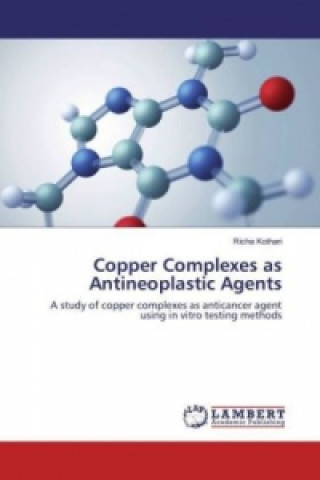
Copper Complexes as Antineoplastic Agents
A study of copper complexes as anticancer agent using in vitro testing methods
 Inglés
 96 b
96 b
Hasta 30 días para devoluciones
Clientes que también han comprado













 /
/
 Tapa blanda
 47.59
€
47.59
€












 /
Tapa blanda
33.29
€
/
Tapa blanda
33.29
€





Metal ion complexes are more interesting and attractive compounds in the development of anticancer drugs because of their chemical reactivity. The possibility of different coordination geometries enables the synthesis of compounds with stereochemistry that are most desirable, unique combination and not obtainable in the group of pure organic compounds. The factors in the structure of metal ion complexes are the type of ligands and the oxidation state of the metal, which regulates the biological activity of the metal-based drugs. Oxidation state often dictates particular coordination geometry. The recently ongoing emphasis has been given to increase the number of therapeutic metal complexes. Historically, metals and metal complexes have played a key role in the development of pharmacological as well as chemotherapeutic substances. Specifically, heavy metals, so called d-block metals, have good cytotoxic potential. Many of these complexes are documented.The study of copper and copper complexes has gained momentum during the recent years as it is very essential element for life. It is incorporated with a number of copper- dependent enzymes that are key in biological process.


Sobre el libro
Inglés

Regale este libro hoy
Es fácil
1 Añadir al carrito y elegir Entregar como regalo en el checkout 2 Le enviaremos un vale 3 El libro llegará a la dirección del destinatarioTambién puede interesarle
 /
Tapa blanda
29.59
€
/
Tapa blanda
29.59
€










 /
Tapa blanda
19.99
€
/
Tapa blanda
19.99
€


 /
Tapa blanda
21.99
€
/
Tapa blanda
21.99
€