
 Contacto
 Cómo comprar

Entrega
Guía de compras
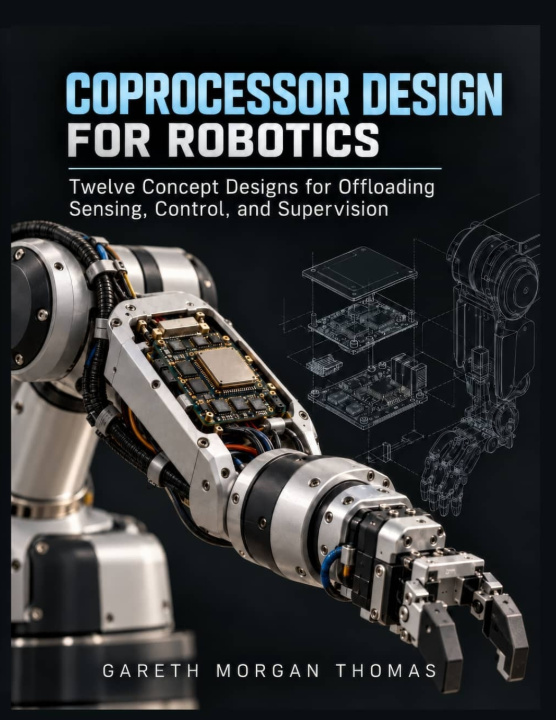
Coprocessor Design for Robotics
Twelve Concept Designs for Offloading Sensing, Control, and Supervision
 Inglés
 83 b
 Popular
 Nuevo
Hasta 30 días para devoluciones
Clientes que también han comprado







What if the smartest way to build a more capable robot is not to keep expanding the central processor-but to move the right computation closer to where it is actually needed?
Coprocessor Design for Robotics explores twelve specialized hardware concepts for offloading sensing, control, supervision, safety, power management, and operator feedback from the main compute stack.
The focus is not acceleration for its own sake. It is better system architecture: lower latency, more predictable timing, reduced data movement, improved fault isolation, and tighter integration between computation and the physical machine.
Inside, you will explore how dedicated coprocessors can:
- Reduce latency in time-critical control paths
- Process raw sensor streams locally before they overload the host
- Improve deterministic behaviour in real-time systems
- Reduce communication and memory bandwidth requirements
- Separate safety-critical supervision from the main autonomy stack
- Support fault detection, graceful degradation, and resilient operation
- Manage power and thermal limits across robotic subsystems
- Accelerate structured computation such as sensor fusion and model-predictive control
The twelve concepts span tactile sensing, event-camera preprocessing, vibration monitoring, compliant actuator control, intelligent end-effectors, legged locomotion, whole-body state estimation, event filtering, independent safety supervision, dynamic power allocation, swarm coordination, and haptic feedback.
Throughout the book, each design is treated as a hardware-software partitioning problem. The central question is always whether specialization creates enough system-level advantage to justify the added hardware, verification, integration, and lifecycle complexity.
For robotics engineers, embedded-system designers, FPGA and ASIC developers, control engineers, mechatronics specialists, and advanced students who want to understand where specialized hardware can genuinely improve robotic systems.
The future of robotics will not depend only on how much computation a machine has.
It will depend on whether the right computation is happening in the right place.


Sobre el libro
Inglés

Regale este libro hoy
Es fácil
1 Añadir al carrito y elegir Entregar como regalo en el checkout 2 Le enviaremos un vale 3 El libro llegará a la dirección del destinatarioTambién puede interesarle


 /
 Tapa blanda
 52.69
€






¡Hola! Soy Libroamiko, tu asesor de libros.
¿Cómo puedo ayudarte?