
 Contacto
 Cómo comprar
Entrega
Guía de compras
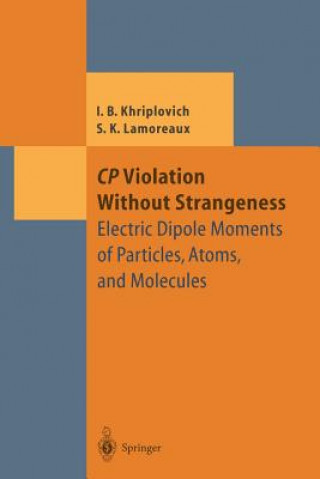
CP Violation Without Strangeness
Electric Dipole Moments of Particles, Atoms, and Molecules
 Inglés
 276 b
276 b
Hasta 30 días para devoluciones
Clientes que también han comprado









 /
/
 Tapa blanda
 35.49
€
35.49
€

Electric dipole moments (EDMs) have interested physicists since 1950, when it was first suggested that there was no experimental evidence that nuclear forces are symmetric under parity (P) transformation. This question was regarded as speculative because the existence of an EDM, in addition to P violation, requires a violation of time-reversal (T) symmetry. In 1964 it was discovered that the invariance under CP transformation, which combines charge conjugation (C) with parity, is violated in K-meson decays. This provided a new incentive for EDM searches. Since the combined operations of CPT are expected to leave a system invariant, breakdown of CP invariance should be accompanied by a violation of time-reversal symmetry. Thus there is a reason to expect that EDMs should exist at some level. The original neutron EDM experiments were later supplemented with checks of T invariance in atoms and molecules. These investigations are pursued now by many groups. Over the years, the upper limit on the neutron EDM has been improved by seven orders of magnitude, and the upper limit on the electron EDM obtained in atomic experiments is even more strict.


Sobre el libro
Inglés

Regale este libro hoy
Es fácil
1 Añadir al carrito y elegir Entregar como regalo en el checkout 2 Le enviaremos un vale 3 El libro llegará a la dirección del destinatarioTambién puede interesarle
 /
Tapa blanda
41.59
€
/
Tapa blanda
41.59
€
 /
/
 Adobe ePub DRM
4.59
€
Adobe ePub DRM
4.59
€
 /
Tapa dura
53.39
€
/
Tapa dura
53.39
€
 /
Tapa dura
33.69
€
/
Tapa dura
33.69
€








¡Hola! Soy Libroamiko, tu asesor de libros.
¿Cómo puedo ayudarte?