
 Contacto
 Cómo comprar
Entrega
Guía de compras
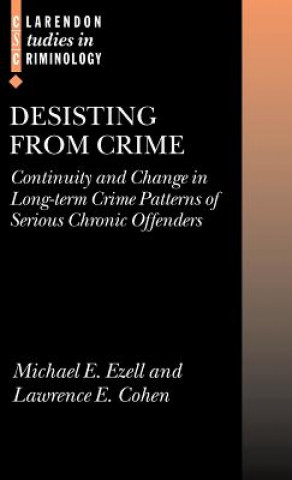
Desisting from Crime
Continuity and Change in Long-term Crime Patterns of Serious Chronic Offenders
 Inglés
 290 b
290 b
Hasta 30 días para devoluciones
Clientes que también han comprado













This groundbreaking study examines patterns of offending among persistent juvenile offenders. The authors address questions that have been the focus of criminological debate over the last two decades. Are there are multiple groups of offenders in the population with distinct age-crime patterns? Are between-person differences in criminal offending patterns stable throughout the offender's life? Is there a relationship between offending at one time and at a subsequent time of life, after time-stable differences in criminal propensity are controlled? Ezell and Cohen address these issues by examining three large, separately drawn samples of serious youthful offenders from California. Each sample was tracked over a long time-period, and sophisticated statistical models were used to test eight empirical hypotheses drawn from three major theories of crime: population heterogeneity, state dependence, and dual taxonomy. Each of these three perspectives offers different predictions about the relationship between age and crime, and the possibility of crime desistance over the life of serious chronic offenders. Despite the serious chronic criminality among the sample offenders, by the time they reached their mid- to late twenties and continuing into their thirties, each of the six latent classes of offender identified by the study had begun to demonstrate a declining number of arrests. This finding has profound implications for penal policies that impose life sentences on multiple offenders, such as the Californian 'three strikes and you're out' which incarcerates inmates for 25 years to life with their 'third strike' conviction, at precisely the point when they have begun to grow out of serious crime.


Sobre el libro
Inglés
Categorías

Regale este libro hoy
Es fácil
1 Añadir al carrito y elegir Entregar como regalo en el checkout 2 Le enviaremos un vale 3 El libro llegará a la dirección del destinatarioTambién puede interesarle

 /
/
 Tapa blanda
 32.79
€
32.79
€




 /
Tapa blanda
25.69
€
/
Tapa blanda
25.69
€
 /
Tapa blanda
112.79
€
/
Tapa blanda
112.79
€
 /
Tapa blanda
17.89
€
/
Tapa blanda
17.89
€
 /
Tapa dura
112.79
€
/
Tapa dura
112.79
€
 /
Tapa blanda
6.99
€
/
Tapa blanda
6.99
€














¡Hola! Soy Libroamiko, tu asesor de libros.
¿Cómo puedo ayudarte?