
 Contacto
 Cómo comprar

Entrega
Guía de compras
 Inglés
 57 b
 Nuevo
Hasta 30 días para devoluciones

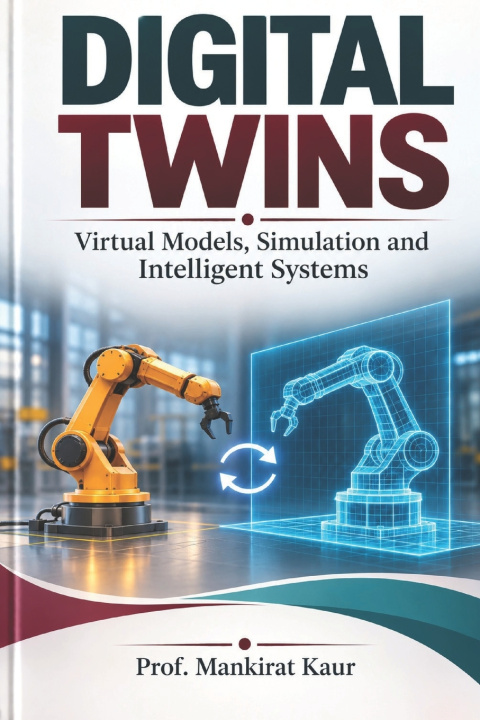
A digital twin is a living virtual counterpart of something real: a machine, a production line, a building, a power grid, a city or even a human organ. It is fed by data from the physical world, it reasons about that data with models, and it sends insight or control back to the physical world. Over the last decade the idea has moved from aerospace research laboratories into factories, hospitals, utilities and software platforms used every day. Engineering graduates are now expected to understand not only what a digital twin is, but how to design, build, validate and operate one.
This book was written to meet that need. It is intended for undergraduate and postgraduate students of computer science, information technology, electronics, electrical and mechanical engineering, and for practising engineers who want a structured, hands-on introduction to the field. The treatment is deliberately broad, because a digital twin is a systems technology that draws on sensing and electronics, networking, mathematical modelling, numerical simulation, data engineering, machine learning, cloud computing, visualisation and cyber security. At the same time, every chapter goes deep enough for the reader to implement working solutions.
The book is organised in sixteen chapters that follow the natural flow of a twin from the physical world to intelligent decision making:
- Chapters 1 and 2 introduce the concept, its history, the vocabulary used in research and industry, and the reference architectures that give structure to real systems.
- Chapters 3 and 4 cover the physical link: sensors, signal conditioning circuits, data acquisition, and the communication protocols that move data into the twin.
- Chapters 5 and 6 develop physics-based modelling and simulation, from differential equations and equivalent circuits to discrete-event simulation, Monte Carlo analysis and co-simulation with the Functional Mock-up Interface.
- Chapters 7 and 8 treat data-driven and hybrid models, and the estimation techniques, including Kalman and particle filters, that keep a virtual model synchronised with reality.
- Chapters 9 and 10 explain the platforms on which twins run, edge, fog and cloud deployment, and the visualisation and immersive interfaces through which people use them.
- Chapters 11 to 13 present applications in predictive maintenance, manufacturing, healthcare, smart cities, energy and transport.
- Chapter 14 addresses security, privacy, trust and standards, and Chapter 15 looks at cognitive and autonomous twins, reinforcement learning and future research directions.
- Chapter 16 brings everything together through complete projects that readers can build in a laboratory or at home.
Teachers can use the book for a one-semester course by covering Chapters 1 to 8 and one application chapter, with a project from Chapter 16 as the laboratory component. A two-semester sequence can cover the complete text, adding platform engineering, security and intelligent twins in the second semester. Self-learners are encouraged to type in and modify the programs, because the fastest way to understand a digital twin is to build one and watch it follow a real system.
Several conventions are used throughout.


Sobre el libro
Inglés

Regale este libro hoy
Es fácil
1 Añadir al carrito y elegir Entregar como regalo en el checkout 2 Le enviaremos un vale 3 El libro llegará a la dirección del destinatario¡Hola! Soy Libroamiko, tu asesor de libros.
¿Cómo puedo ayudarte?