
 Contacto
 Cómo comprar
Entrega
Guía de compras
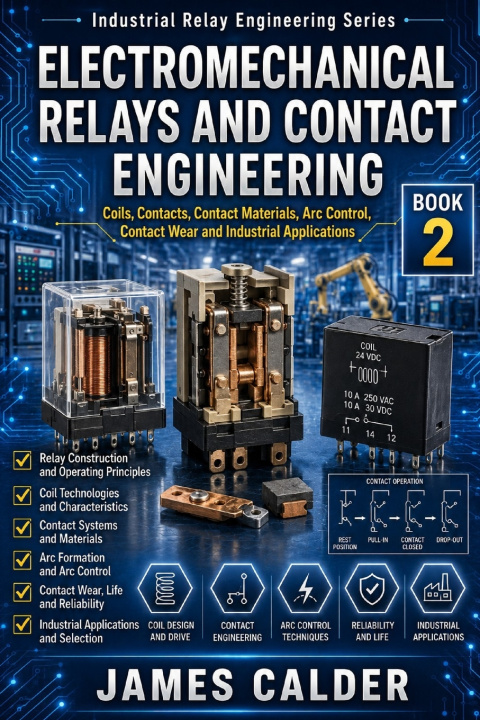
ELECTROMECHANICAL RELAYS AND CONTACT ENGINEERING
Coils, Contacts, Contact Materials, Arc Control, Contact Wear and Industrial Applications
 Inglés
 63 b
63 b
 Nuevo
Nuevo
Hasta 30 días para devoluciones

ELECTROMECHANICAL RELAYS AND CONTACT ENGINEERING
Electromechanical relays remain essential components in industrial control, automation, machine safety, interface circuits, and power switching. Their construction appears simple, but reliable operation depends on many interacting factors: coil behavior, magnetic force, contact geometry, contact materials, load characteristics, switching frequency, arc formation, temperature, contamination, and mechanical wear.
ELECTROMECHANICAL RELAYS AND CONTACT ENGINEERING is a practical engineering guide to the internal behavior, application, selection, and failure mechanisms of industrial electromechanical relays.
The book focuses on what happens inside a relay during real switching events and explains why contacts that look acceptable can develop high resistance, intermittent operation, excessive heating, welding, erosion, or complete failure.
What You Will Learn
Relay construction and electromagnetic operating principles
Coil voltage, current, resistance, power, pickup, and dropout behavior
Magnetic circuits, armatures, springs, and mechanical movement
NO, NC, changeover, and multi-pole contact arrangements
Contact force, contact resistance, bounce, and transfer behavior
Silver alloys and other contact materials used in industrial relays
How load type affects contact life and switching capability
Resistive, inductive, capacitive, lamp, and DC loads
Inrush current and its effect on relay contacts
Arc formation during contact opening and closing
Contact erosion, pitting, oxidation, contamination, and material transfer
Contact welding and the conditions that cause it
Mechanical life versus electrical life
AC and DC switching differences
Flyback diodes, RC snubbers, varistors, and arc suppression
Derating for temperature, current, voltage, and switching frequency
Relay heating and coil overvoltage or undervoltage
Intermittent relay faults and difficult contact problems
Measurement of coil and contact conditions
Practical diagnostic methods for industrial maintenance
Failure prevention and correct replacement selection
Practical Engineering Approach
A relay can click normally and still fail electrically. A contact can show continuity with a multimeter but produce a large voltage drop under load. A relay may work for thousands of operations on one load and fail rapidly when connected to another load with the same nominal current.
This book explains why.
Readers learn to evaluate the complete electromechanical switching process rather than treating the relay as a simple ON/OFF component. The discussion connects internal relay physics with real factory symptoms such as intermittent machine stops, unstable signals, overheated terminals, damaged contacts, welded outputs, and repeated replacement failures.
The goal is to identify not only which relay has failed, but why the failure occurred and what should be changed to prevent it from returning.
Who This Book Is For
This book is intended for industrial electricians, maintenance technicians, automation engineers, electrical engineers, PLC programmers, panel builders, machine builders, commissioning technicians, service personnel, engineering students, and professionals responsible for industrial electrical systems.
It is especially useful for anyone who needs to understand relay contacts beyond basic current ratings and make better decisions when selecting, testing, troubleshooting, or replacing electromechanical relays.


Sobre el libro
Inglés

Regale este libro hoy
Es fácil
1 Añadir al carrito y elegir Entregar como regalo en el checkout 2 Le enviaremos un vale 3 El libro llegará a la dirección del destinatario¡Hola! Soy Libroamiko, tu asesor de libros.
¿Cómo puedo ayudarte?