
 Contacto
 Cómo comprar
Entrega
Guía de compras
 Inglés
 290 b
290 b
Hasta 30 días para devoluciones
Clientes que también han comprado









 /
/
 Tapa blanda
 11.39
€
11.39
€

 /
Tapa blanda
14.19
€
/
Tapa blanda
14.19
€



 /
Tapa blanda
30.29
€
/
Tapa blanda
30.29
€


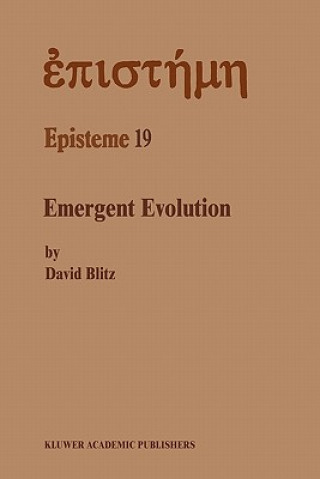
Emergent evolution combines three separate but related claims, whose background, origin, and development I trace in this work: firstly, that evolution is a universal process of change, one which is productive of qualitative novelties; secondly, that qualitative novelty is the emergence in a system of a property not possessed by any of its parts; and thirdly, that reality can be analyzed into levels, each consisting of systems characterized by significant emergent properties. In part one I consider the background to emergence in the 19th century discussion of the philosophy of evolution among its leading exponents in England - Charles Darwin, Herbert Spencer, T. H. Huxley, Alfred Russel Wallace, and G. J. Romanes. Unlike the scientific aspect of the debate which aimed to determine the factors and causal mechanism of biological evolution, this aspect of the debate centered on more general problems which form what I call the "philosophical framework for evolutionary theory." This considers the status of continuity and discontinuity in evolution, the role of qualitative and quantitative factors in change, the relation between the organic and the inorganic, the relation between the natural and the supernatural, the mind-body problem, and the scope of evolution, including its extension to ethics and morals.


Sobre el libro
Inglés

Regale este libro hoy
Es fácil
1 Añadir al carrito y elegir Entregar como regalo en el checkout 2 Le enviaremos un vale 3 El libro llegará a la dirección del destinatarioTambién puede interesarle



 /
Tapa blanda
13.49
€
/
Tapa blanda
13.49
€








 /
Tapa dura
30.39
€
/
Tapa dura
30.39
€

 /
/
 Adobe ePub DRM
19.19
€
Adobe ePub DRM
19.19
€


 /
Tapa blanda
34.99
€
/
Tapa blanda
34.99
€







 /
Tapa dura
200.39
€
/
Tapa dura
200.39
€
¡Hola! Soy Libroamiko, tu asesor de libros.
¿Cómo puedo ayudarte?