Contacto
 Cómo comprar
Entrega
Guía de compras
 Inglés
 179 b
179 b
Hasta 30 días para devoluciones
Clientes que también han comprado


 /
/
 Tapa blanda
 26.49
€
26.49
€

 /
Tapa blanda
27.29
€
/
Tapa blanda
27.29
€







 /
Tapa blanda
26.09
€
/
Tapa blanda
26.09
€



 /
Tapa blanda
85.39
€
/
Tapa blanda
85.39
€



 /
Tapa blanda
10.29
€
/
Tapa blanda
10.29
€

 /
Tapa blanda
19.99
€
/
Tapa blanda
19.99
€




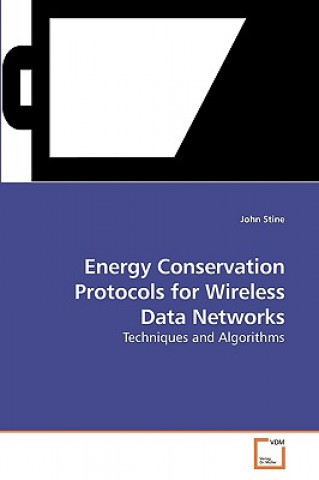
This thesis studies the use of wireless medium access control (MAC) protocols to conserve energy in wireless portable radios, in both centrally controlled and ad hoc networks. In the former, it compares methods of scheduling, methods of announcing schedules, and various access techniques. It concludes that there are two primary objectives. First, MAC protocols should put nodes not participating in data exchanges into a low energy state. Second, information that enables these nodes to enter these states must be provided quickly. These objectives are not easily applied in ad hoc networks because most ad hoc MAC protocols rely on temporally random access techniques. As a result, we created a new MAC protocol called Synchronous Collision Resolution (SCR). SCR assumes nodes are synchronized and thus can contend simultaneously. A collision resolution signaling mechanism resolves contentions. The predictability of SCR simplifies the implementation of energy conservation mechanisms. Additionally, SCR orchestrates spatial reuse of spectrum, enables the effective use of multiple channels, arbitrates access based on priority and enables reservations for streaming.


Sobre el libro
Inglés

Regale este libro hoy
Es fácil
1 Añadir al carrito y elegir Entregar como regalo en el checkout 2 Le enviaremos un vale 3 El libro llegará a la dirección del destinatarioTambién puede interesarle
 /
Tapa blanda
73.09
€
/
Tapa blanda
73.09
€
 /
Tapa blanda
13.99
€
/
Tapa blanda
13.99
€




 /
Tapa blanda
25.89
€
/
Tapa blanda
25.89
€






 /
Tapa blanda
33.69
€
/
Tapa blanda
33.69
€









 /
Tapa dura
153.09
€
/
Tapa dura
153.09
€