
 Contacto
 Cómo comprar
Entrega
Guía de compras
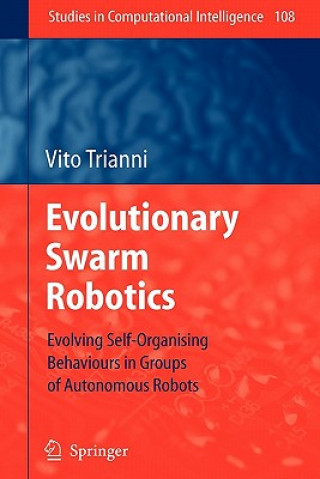
Evolutionary Swarm Robotics
Evolving Self-Organising Behaviours in Groups of Autonomous Robots
 Inglés
 398 b
398 b
Hasta 30 días para devoluciones
Clientes que también han comprado







 /
/
 Tapa blanda
 12.29
€
12.29
€




 /
Tapa dura
37.49
€
/
Tapa dura
37.49
€



In this book the use of ER techniques for the design of self-organising group behaviours, for both simulated and real robots is introduced. The book tries to mediate between two apparently opposed perspectives: engineering and cognitive science. The experiments presented in the book and the results obtained contribute to the assessment of ER not only as a design tool, but also as a methodology for modelling and understanding intelligent adaptive behaviours.In this book the use of ER techniques for the design of self-organising group behaviours, for both simulated and real robots is introduced. This research has a twofold value. From an engineering perspective, an automatic methodology for synthesising complex behaviours in a robotic system is described.§ER techniques should be used in order to obtain robust and efficient group behaviours based on self-organisation. From a more theoretical point of view, the second important contribution brought forth by the author's experiments concerns the understanding of the basic principles underlying self-organising behaviours and collective intelligence. In this experimental work, the evolved behaviours are analysed in order to uncover the mechanisms that have led to a certain organisation. §In summary, this book tries to mediate between two apparently opposed perspectives: engineering and cognitive science. The experiments presented and the results obtained contribute to the assessment of ER not only as a design tool, but also as a methodology for modelling and understanding intelligent adaptive behaviours.


Sobre el libro
Inglés
Categorías

Regale este libro hoy
Es fácil
1 Añadir al carrito y elegir Entregar como regalo en el checkout 2 Le enviaremos un vale 3 El libro llegará a la dirección del destinatarioTambién puede interesarle




 /
Tapa blanda
15.39
€
/
Tapa blanda
15.39
€







¡Hola! Soy Libroamiko, tu asesor de libros.
¿Cómo puedo ayudarte?