
 Contacto
 Cómo comprar

Entrega
Guía de compras
 Inglés
 61 b
 Nuevo
Hasta 30 días para devoluciones

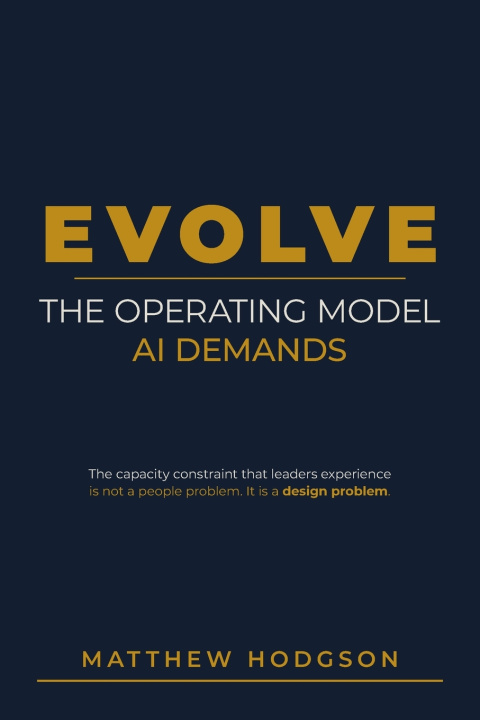
Evolve: The Operating Model AI Demands makes a structural argument: the Plan-Build-Run technical operating model is the binding constraint preventing organisations from capturing AI value at scale, and the product operating model is the governance form that enables continuous evolution.
The urgency is empirical. Boston Consulting Group's survey of 1,250 senior executives across nine industries identifies three distinct performance tiers: approximately 5% of organisations are achieving AI value at scale, 35% are generating partial returns, and 60% report minimal gains (Boston Consulting Group, 2025). The critical insight is that the 5% are not using more AI tools than the 60%-they have redesigned their processes around AI capability. As Brynjolfsson and McAfee (2014) identify, realising technology's productivity potential requires restructuring work around what the technology makes possible, not computerising existing tasks.
The book diagnoses the structural reason most organisations cannot make that transition. Plan-Build-Run separates strategy, delivery, and operations into sequential phases governed by handovers, approvals, and project-scoped funding. That design cannot adapt at operating speed. Every AI cycle produces learning the operating model has no mechanism to act on.
Organised across four parts, Evolve moves from diagnosis to prescription. Part I establishes that the AI performance divergence is a governance fitness gap. Part II presents the product operating model as a complete governance architecture-unit of work, team topology, funding model, and decision authority. Part III extends that governance form to AI teams, using the Relentless Raptors-a nine-member Scrum team of one human Product Owner and eight AI agents, operating in production for over twelve months-as the existence proof (Hodgson & West, 2026). Part IV specifies the four structural commitments executives must make for the transition to hold.
Written for CIOs, CDOs, and senior executives in Australian government and corporate settings, the book is diagnostic-first: it identifies structural root causes, not execution failures, and equips the executive to act on what each operating cycle reveals.


Sobre el libro
Inglés

Regale este libro hoy
Es fácil
1 Añadir al carrito y elegir Entregar como regalo en el checkout 2 Le enviaremos un vale 3 El libro llegará a la dirección del destinatario¡Hola! Soy Libroamiko, tu asesor de libros.
¿Cómo puedo ayudarte?