
 Contacto
 Cómo comprar
Entrega
Guía de compras
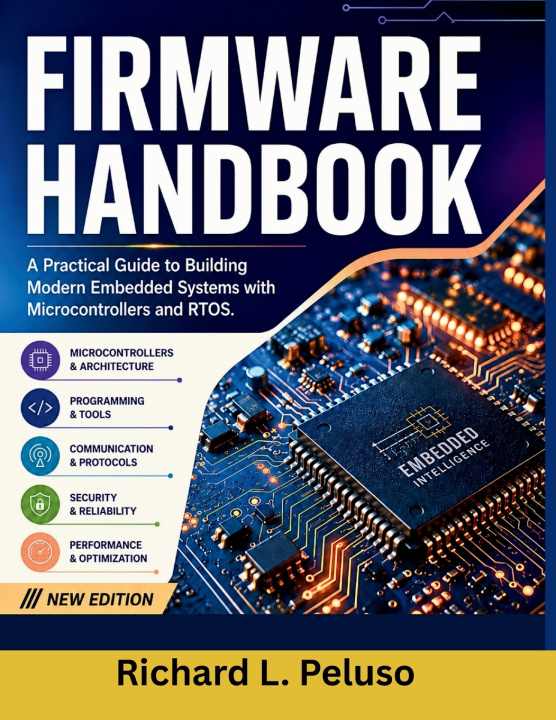
Firmware Handbook
A Practical Guide to Building Modern Embedded Systems with Microcontrollers and RTOS
 Inglés
 150 b
150 b
 Próximamente
 Nuevo
Nuevo
Hasta 30 días para devoluciones

Modern products-from smart home devices and medical instruments to industrial controllers, automotive electronics, and IoT systems-depend on robust firmware. Yet many engineers struggle to connect theory with practical implementation. Firmware Handbook bridges that gap by providing a clear, hands-on guide to designing, developing, debugging, and maintaining real embedded systems using modern microcontrollers and real-time operating systems (RTOS).
This book is written for readers who want practical knowledge, not just academic theory. It explains complex concepts in straightforward language and demonstrates how firmware components work together in real projects.
Inside this comprehensive handbook, you will learn how to:
- Understand microcontroller architecture, memory systems, buses, peripherals, and startup behaviour
- Configure GPIO, timers, interrupts, ADCs, DACs, UART, SPI, I²C, CAN, USB, and other common interfaces
- Write efficient, maintainable, and portable embedded C firmware
- Design deterministic real-time applications using RTOS tasks, scheduling, queues, semaphores, mutexes, event flags, and timers
- Manage memory safely and avoid fragmentation, stack overflow, and hard-to-find runtime faults
- Implement low-power techniques for battery-powered and energy-efficient devices
- Use debugging tools such as SWD/JTAG, breakpoints, watchpoints, trace, logic analysers, and oscilloscopes
- Develop reliable bootloaders and firmware update mechanisms
- Build interrupt-driven and event-driven systems with predictable timing
- Apply defensive programming, fault handling, watchdog recovery, and safety-oriented design practices
- Test firmware effectively using unit testing, integration testing, hardware-in-the-loop methods, and continuous integration workflows
- Organise firmware projects for scalability, teamwork, version control, documentation, and long-term maintenance.
What makes this book different?
Unlike many embedded books that focus heavily on mathematics or vendor-specific details, Firmware Handbook emphasises practical engineering decisions. Each topic is presented with real-world context, implementation guidance, design trade-offs, and best practices used in professional embedded development.
Whether you are creating your first microcontroller project or developing complex RTOS-based products, this handbook provides a structured path from fundamentals to advanced firmware engineering.
If you want a practical reference that you can keep beside your development board and return to throughout your career, Firmware Handbook is the resource you have been looking for.


Sobre el libro
Inglés

Regale este libro hoy
Es fácil
1 Añadir al carrito y elegir Entregar como regalo en el checkout 2 Le enviaremos un vale 3 El libro llegará a la dirección del destinatario¡Hola! Soy Libroamiko, tu asesor de libros.
¿Cómo puedo ayudarte?