
 Contacto
 Cómo comprar
Entrega
Guía de compras
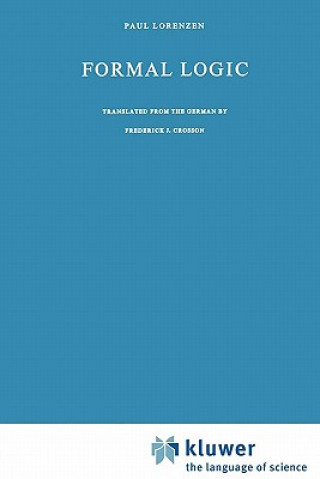
Formal Logic
 Inglés
 276 b
276 b
Política de devolución de 30 días
Clientes que también han comprado
















 /
/
 Tapa blanda
 63.89
€
63.89
€


"Logic", one of the central words in Western intellectual history, compre hends in its meaning such diverse things as the Aristotelian syllogistic, the scholastic art of disputation, the transcendental logic of the Kantian critique, the dialectical logic of Hegel, and the mathematical logic of the Principia Mathematica of Whitehead and Russell. The term "Formal Logic", following Kant is generally used to distinguish formal logical reasonings, precisely as formal, from the remaining universal truths based on reason. (Cf. SCHOLZ, 1931). A text-book example of a formal-logical inference which from "Some men are philosophers" and "All philosophers are wise" concludes that "Some men are wise" is called formal, because the validity of this inference depends only on the form ofthe given sentences -in particular it does not depend on the truth or falsity of these sentences. (On the dependence of logic on natural language, English, for example, compare Section 1 and 8). The form of a sentence like "Some men are philosophers", is that which remains preserved when the given predicates, here "men" and "philosophers" are replaced by arbitrary ones. The form itself can thus be represented by replacing the given predicates by variables. Variables are signs devoid of meaning, which may serve merely to indicate the place where meaningful constants (here the predicates) are to be inserted. As variables we shall use - as did Aristotle - letters, say P, Q and R, as variables for predicates.


Sobre el libro
Inglés
Categorías

Regale este libro hoy
Es fácil
1 Añadir al carrito y elegir Entregar como regalo en el checkout 2 Le enviaremos un vale 3 El libro llegará a la dirección del destinatarioTambién puede interesarle

















¡Hola! Soy Libroamiko, tu asesor de libros.
¿Cómo puedo ayudarte?