
 Contacto
 Cómo comprar
Entrega
Guía de compras
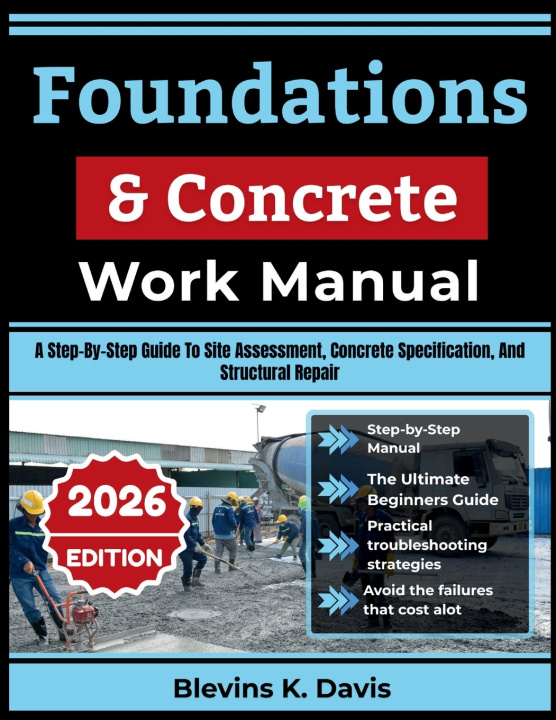
Foundations & Concrete Work Manual
A Step-By-Step Guide To Site Assessment, Concrete Specification, And Structural Repair
 Inglés
 266 b
266 b
 Próximamente
 Nuevo
Nuevo
Hasta 30 días para devoluciones

This book ''Foundations & Concrete Work Manual'' is your complete, practical guide to understanding, designing, specifying, forming, placing, curing, and repairing the concrete foundations and site structures of modern buildings - explained in plain language, supported by worked calculations and code citations, and current to the standards and materials defining construction practice right now.
This book was written for you if you are:
- A residential concrete contractor who wants to understand why the standards require what they require - not just what the table says
- A foundation superintendent coordinating complex pours on challenging sites in hot sun, freezing cold, or expansive clay
- A building inspector who needs a reliable desk reference for cover, spacing, compressive strength, and drainage requirements
- A construction student building the technical foundation for a career in concrete, structural, or site work
- A general contractor who needs fluency in foundation coordination - soils, waterproofing, anchorage, and energy code - on every project
- A residential designer or architect who specifies foundations and needs current code confidence
- A foundation repair professional diagnosing settlement, bowing walls, and water entry in the existing building stock
Inside, You Will Learn How to:
- Read a site, classify a soil, and match the right foundation system to the conditions beneath it - before a single stake is driven
- Specify concrete correctly using ACI 318 exposure classes - the F, S, W, and C requirements that determine what you actually order, not just "4,000 psi"
- Navigate the Type IL cement transition - why your batch ticket now says Type IL, what it means for your finishing window, and how the reduced bleed water changes every slab pour
- Comply with ACI 323-24, the first low-carbon concrete code in American history - how to read an EPD, set a GWP budget, and document Buy Clean compliance
- Engineer formwork that will not blow out - calculate lateral form pressure using the ACI 347 method for the actual temperature, rate, and mix chemistry of every pour
- Place reinforcement exactly where the engineer put it - cover, chairs, development lengths, lap splices, and the corner detail that prevents the most common foundation crack
- Cure concrete to the strength the design assumed - why curing is not the same as drying, and what ACI 308 requires for each mix type and exposure condition
- Size, sequence, and sawcut control joints - the timing window that must not be missed, the depth of cut that must be achieved, and the consequences of getting both wrong
- Waterproof, drain, air-seal, and insulate below-grade assemblies - the complete system that passes the 2024 IECC blower door test, controls radon, and survives the water table
Bonus Field Companion - Your On-Site Toolkit:
- Estimating and Procurement Guide
- Inspector's Checklists
- Field Reference Tables
- Troubleshooting Directory
This is not a collection of disconnected magazine articles reorganized by theme. Every chapter builds on the last the way real buildings are constructed - from site assessment through soil classification, footing design, wall systems, slab configurations, placement and finishing, curing and jointing, moisture management, and structural repair.
You will specify more confidently, build more correctly, document more thoroughly, and understand foundations as complete engineering systems - not just dimensions on a footing plan.
If you are ready to master foundation and concrete work with the technical depth and current code accuracy the profession now demands, this is your essential guide.
Scroll up and get your copy today - and build foundations worth standing on for the next fifty years.<...


Sobre el libro
Inglés

Regale este libro hoy
Es fácil
1 Añadir al carrito y elegir Entregar como regalo en el checkout 2 Le enviaremos un vale 3 El libro llegará a la dirección del destinatario¡Hola! Soy Libroamiko, tu asesor de libros.
¿Cómo puedo ayudarte?