
 Contacto
 Cómo comprar
Entrega
Guía de compras
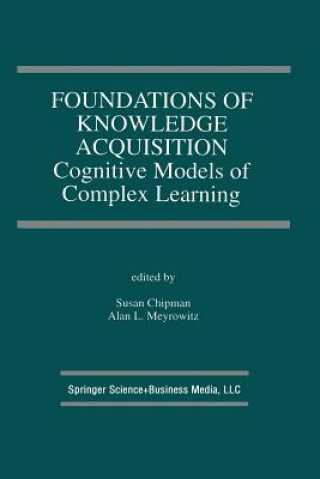
Foundations of Knowledge Acquisition
Cognitive Models of Complex Learning
 Inglés
 373 b
373 b
Hasta 30 días para devoluciones
Clientes que también han comprado

 /
/
 Tapa blanda
 35.49
€
35.49
€




One of the most intriguing questions about the new computer technology that has appeared over the past few decades is whether we humans will ever be able to make computers learn. As is painfully obvious to even the most casual computer user, most current computers do not. Yet if we could devise learning techniques that enable computers to routinely improve their performance through experience, the impact would be enormous. The result would be an explosion of new computer applications that would suddenly become economically feasible (e. g. , personalized computer assistants that automatically tune themselves to the needs of individual users), and a dramatic improvement in the quality of current computer applications (e. g. , imagine an airline scheduling program that improves its scheduling method based on analyzing past delays). And while the potential economic impact ofsuccessful learning methods is sufficient reason to invest in research into machine learning, there is a second significant reason: studying machine learning helps us understand our own human learning abilities and disabilities, leading to the possibility of improved methods in education. While many open questions remain aboutthe methods by which machines and humans might learn, significant progress has been made.


Sobre el libro
Inglés

Regale este libro hoy
Es fácil
1 Añadir al carrito y elegir Entregar como regalo en el checkout 2 Le enviaremos un vale 3 El libro llegará a la dirección del destinatarioTambién puede interesarle









 /
Tapa blanda
35.79
€
/
Tapa blanda
35.79
€




 /
Tapa dura
108.99
€
/
Tapa dura
108.99
€
¡Hola! Soy Libroamiko, tu asesor de libros.
¿Cómo puedo ayudarte?