
 Contacto
 Cómo comprar

Entrega
Guía de compras
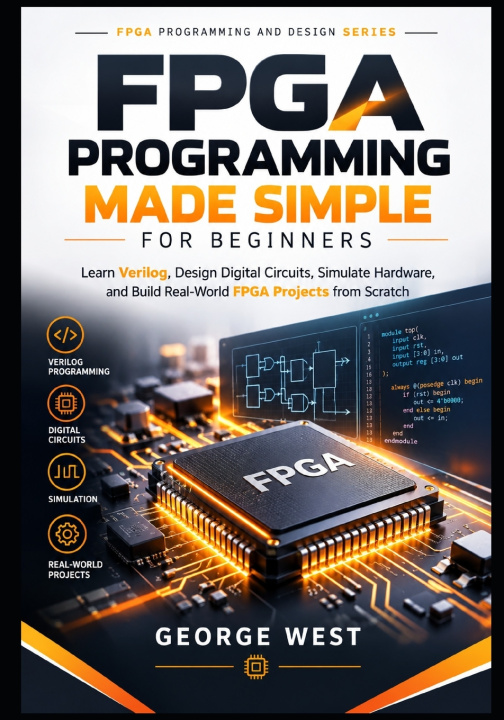
FPGA Programming Made Simple for Beginners
Learn Verilog, Design Digital Circuits, Simulate Hardware, and Build Real-World FPGA Projects from Scratch
 Inglés
 43 b
 Nuevo
Hasta 30 días para devoluciones

Are you ready to learn FPGA programming but unsure where to begin? Do terms like Verilog, digital logic, hardware simulation, and programmable logic seem complicated or intimidating?
FPGA Programming Made Simple for Beginners by George West provides a practical, step-by-step introduction to FPGA development, helping you understand how digital hardware works and how to design your own circuits using Verilog HDL.
Unlike approaches that focus heavily on theory or programming syntax alone, this book connects fundamental concepts to practical hardware design workflows, helping you understand not just what to write, but how your code becomes a working digital circuit.
Inside this book, you will discover how to:
Understand FPGA architecture, programmable logic, and the differences between hardware and software programming.
Learn digital logic fundamentals, including Boolean algebra, logic gates, combinational circuits, and sequential systems.
Write Verilog HDL code to describe digital circuits, modules, signals, and hardware behavior.
Design counters, timers, registers, multiplexers, and finite state machines.
Create testbenches and simulate digital circuits before implementing them on physical hardware.
Understand logic synthesis and how Verilog descriptions map to FPGA resources.
Work with clock signals, resets, input/output pins, and basic timing constraints.
Build practical projects that reinforce your knowledge and develop your hardware design skills.
Identify common coding mistakes, interpret simulation results, and troubleshoot hardware implementation problems.
Develop a foundation for more advanced FPGA applications and digital system engineering.
Who Is This Book For?
This book is designed for beginners, engineering and computer science students, electronics enthusiasts, software developers exploring digital hardware, and aspiring FPGA engineers. No previous FPGA programming experience is required. Basic familiarity with computers and logical reasoning will help, but the concepts are introduced progressively.
By the end of this book, you will have a clearer understanding of FPGA programming, the ability to develop and simulate basic digital designs, and a practical foundation for building more complex hardware systems.
Start your FPGA journey with a practical approach to learning digital hardware, writing Verilog, and turning design ideas into working circuits.


Sobre el libro
Inglés

Regale este libro hoy
Es fácil
1 Añadir al carrito y elegir Entregar como regalo en el checkout 2 Le enviaremos un vale 3 El libro llegará a la dirección del destinatario¡Hola! Soy Libroamiko, tu asesor de libros.
¿Cómo puedo ayudarte?