
 Contacto
 Cómo comprar
Entrega
Guía de compras
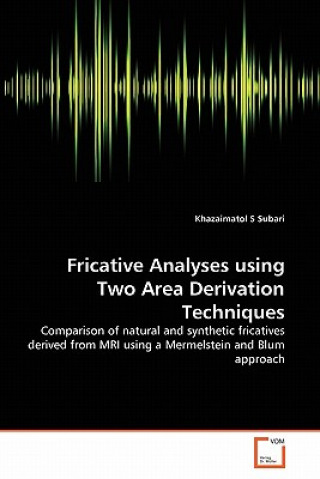
Fricative Analyses using Two Area Derivation Techniques
 Inglés
 207 b
207 b
Política de devolución de 30 días
Clientes que también han comprado












 /
/
 Tapa blanda
 28.69
€
28.69
€








It is still unclear to speech scientists how the brain is able to distinguish fricative sounds from the many cues within the speech signal. The work here makes an acoustic and aticulatory investigation into the problem, using fricative utterances and magnetic resonance (MR) images. The objective is to determine the perceptually important features of the fricative sound, by comparing the acoustic spectra and synthetic sounds derived from two area-derivation methods known as the Mermelstein technique and the Blum transform which are distinct from one other in terms of the treatment of the sublingual cavity and pyriform sinuses. Thus, for each fricative articulation, two sets of area functions representing the vocal tract airway are derived, two sets of predicted spectra and consequently, two synthetic sounds. The degree of match between the measured and predicted spectra is quantified, and the synthetic and natural sounds are used in a perceptual experiment. This unique approach enables comparison of two sets of data and a hypothesis about the features of the acoustic spectra and the articulatory aspects that are perceptually important to the listener.


Sobre el libro
Inglés

Regale este libro hoy
Es fácil
1 Añadir al carrito y elegir Entregar como regalo en el checkout 2 Le enviaremos un vale 3 El libro llegará a la dirección del destinatarioTambién puede interesarle



 /
/
 Diario
17.89
€
Diario
17.89
€
 /
Tapa blanda
78.59
€
/
Tapa blanda
78.59
€




 /
Tapa blanda
24.79
€
/
Tapa blanda
24.79
€












¡Hola! Soy Libroamiko, tu asesor de libros.
¿Cómo puedo ayudarte?