Contacto
 Cómo comprar
Entrega
Guía de compras
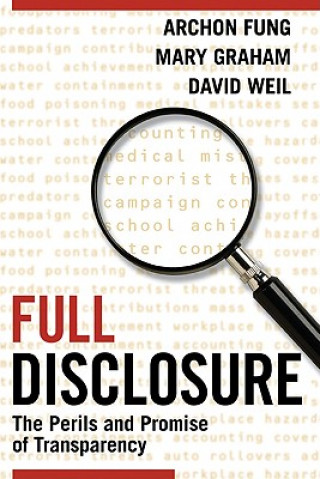
Full Disclosure
 Inglés
 97 b
97 b
Política de devolución de 30 días
Clientes que también han comprado



Governments in recent decades have employed public disclosure strategies to reduce risks, improve public and private goods and services, and reduce injustice. In the United States, these targeted transparency policies include financial securities disclosures, nutritional labels, school report cards, automobile rollover rankings, and sexual offender registries. They constitute a light-handed approach to governance that empowers citizens. However, as Full Disclosure shows these policies are frequently ineffective or counterproductive. Based on a comparative analysis of eighteen major policies, the authors suggest that transparency policies often produce information that is incomplete, incomprehensible, or irrelevant to the consumers, investors, workers, and community residents who could benefit from them. Sometimes transparency fails because those who are threatened by it form political coalitions to limit or distort information. To be successful, transparency policies must place the needs of ordinary citizens at centre stage and produce information that informs their everyday choices.


Sobre el libro
Inglés
Categorías

Regale este libro hoy
Es fácil
1 Añadir al carrito y elegir Entregar como regalo en el checkout 2 Le enviaremos un vale 3 El libro llegará a la dirección del destinatarioTambién puede interesarle






 /
/
 Tapa dura
 123.59
€
123.59
€