
 Contacto
 Cómo comprar
Entrega
Guía de compras
 Inglés
 40 b
40 b
 Nuevo
Nuevo
Hasta 30 días para devoluciones

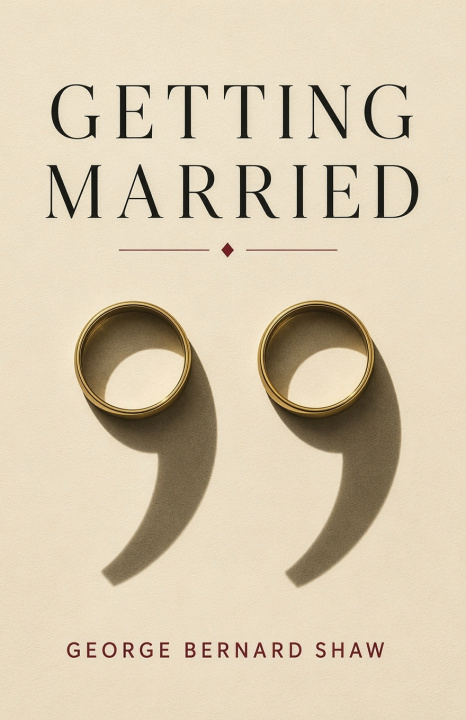
A wedding is about to take place-but before anyone gets married, George Bernard Shaw wants to know whether marriage itself makes any sense.
On the morning of Edith Bridgenorth's wedding to Cecil Sykes, family and friends gather at the home of the Bishop of Chelsea. What should be a conventional celebration quickly becomes something far more complicated. Around the prospective bride and groom are men and women whose experiences of love, marriage, separation, desire, and independence expose just how difficult it is to fit human relationships within a single set of social and legal rules.
First performed in 1908, Getting Married is less a conventional romantic comedy than a provocative examination of marriage as an institution. Shaw turns a wedding gathering into a wide-ranging debate about divorce, monogamy, sexual morality, economic dependence, religious authority, jealousy, parenthood, and the legal obligations created when two people marry.
At the center of Shaw's argument is a deceptively simple problem: society treats marriage as a universal institution while human beings-and their relationships-are anything but uniform. Some characters seek independence within marriage; others question whether marriage can survive desire, incompatibility, or changing circumstances. The law promises order, but Shaw repeatedly asks whether rigid rules can accommodate the unpredictable realities of affection and human behavior.
The women in the play are particularly important to Shaw's examination of marriage. Questions of economic freedom and personal autonomy complicate traditional assumptions about husbands, wives, and dependence. Marriage is therefore not merely a matter of romance. It is also a legal, financial, religious, and social arrangement capable of determining how individuals are permitted to live.
Shaw approaches these questions with characteristic wit, allowing competing arguments to collide rather than supplying an easy formula for successful relationships. Characters who appear unconventional can prove unexpectedly perceptive, while respectable assumptions become increasingly difficult to defend. The result is a comedy driven not by mistaken identities or romantic misunderstandings, but by the unsettling realization that society's most familiar institution may rest upon contradictions few people stop to examine.
More than a century after its first performance, Getting Married remains fascinating because Shaw refuses to ask merely who should marry whom. He asks the more disruptive question of what marriage should require of anyone at all. Funny, argumentative, and deliberately provocative, the play transforms a wedding day into an examination of love, freedom, responsibility, and the rules society creates to govern intimate life.


Sobre el libro
Inglés

Regale este libro hoy
Es fácil
1 Añadir al carrito y elegir Entregar como regalo en el checkout 2 Le enviaremos un vale 3 El libro llegará a la dirección del destinatario¡Hola! Soy Libroamiko, tu asesor de libros.
¿Cómo puedo ayudarte?