
 Contacto
 Cómo comprar
Entrega
Guía de compras
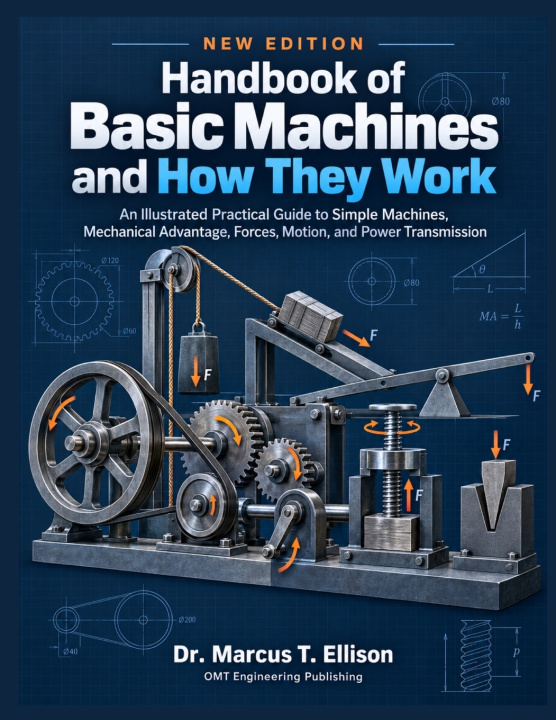
Handbook of Basic Machines and How They Work
An Illustrated Guide to Mechanical Principles, Components, Motion, Power Transmission, Operation, Maintenance, and Safety
 Inglés
 259 b
259 b
 Próximamente
 Nuevo
Nuevo
Hasta 30 días para devoluciones

Understand the machines that move, lift, hold, cut, fasten, and transmit power.
Handbook of Basic Machines and How They Work is a clear, illustrated guide to simple machines, mechanical advantage, forces, motion, and power transmission. It explains how common mechanical systems work, why their performance changes, and how to study them safely and accurately.
The book begins with the foundations of engineering mechanics, including force, work, energy, power, efficiency, materials, friction, wear, and lubrication. It then explains the six simple machines: the lever, wheel and axle, pulley, inclined plane, wedge, and screw.
Readers will also learn about:
- Levers, pulleys, gears, cranks, and handwheels
- Wheels, axles, wedges, screws, and threaded mechanisms
- Ropes, belts, chains, and flexible power transmission
- Mechanical advantage, velocity ratio, torque, and efficiency
- Machine elements, compound machines, and everyday mechanisms
- Load movement, support, balance, and stability
- Measurement, performance testing, and basic machine design
- Inspection, maintenance, troubleshooting, and machine safety
Technical ideas are presented in simple English without removing the engineering detail needed for serious study. The book also explains the limits of common formulas and shows how friction, condition, geometry, and material choice affect real machine performance.
This handbook is written for engineering students, technicians, apprentices, instructors, workshop learners, maintenance personnel, and anyone studying mechanics for the first time. It can be used as a course companion, training reference, classroom resource, or practical introduction to mechanical engineering.
Build a strong understanding of basic machines and learn how separate mechanical parts work together as complete systems.


Sobre el libro
Inglés

Regale este libro hoy
Es fácil
1 Añadir al carrito y elegir Entregar como regalo en el checkout 2 Le enviaremos un vale 3 El libro llegará a la dirección del destinatario¡Hola! Soy Libroamiko, tu asesor de libros.
¿Cómo puedo ayudarte?