Contacto
 Cómo comprar
Entrega
Guía de compras
Impossible
 Inglés
 301 b
301 b
Política de devolución de 30 días
Clientes que también han comprado

 /
/
 Tapa blanda
 14.89
€
14.89
€






 /
Tapa blanda
39.39
€
/
Tapa blanda
39.39
€


 /
Tapa blanda
39.39
€
/
Tapa blanda
39.39
€

 /
Tapa blanda
47.29
€
/
Tapa blanda
47.29
€





 /
Tapa blanda
18.49
€
/
Tapa blanda
18.49
€













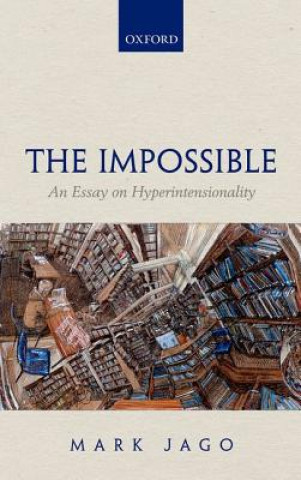
Mark Jago presents an original philosophical account of meaningful thought: in particular, how it is meaningful to think about things that are impossible. We think about impossible things all the time. We can think about alchemists trying to turn base metal to gold, and about unfortunate mathematicians trying to square the circle. We may ponder whether god exists; and philosophers frequently debate whether properties, numbers, sets, moral and aesthetic qualities, and qualia exist. In many philosophical or mathematical debates, when one side of the argument gets things wrong, it necessarily gets them wrong. As we consider both sides of one of these philosophical arguments, we will at some point think about something that's impossible. Yet most philosophical accounts of meaning and content hold that we can't meaningfully think or reason about the impossible. In The Impossible, Jago argues that we often gain new information, new beliefs and, sometimes, fresh knowledge through logic, mathematics and philosophy. That is why logic, mathematics, and philosophy are useful. We therefore require accounts of knowledge and belief, of information and content, and of meaning which allow space for the impossible. Jago's aim in this book is to provide such accounts. He gives a detailed analysis of the concept of hyperintensionality, whereby logically equivalent contents may be distinct, and develops a theory in terms of possible and impossible worlds. Along the way, he provides a theory of what those worlds are and how they feature in our analysis of normative epistemic concepts: knowledge, belief, information, and content.


Sobre el libro
Inglés

Regale este libro hoy
Es fácil
1 Añadir al carrito y elegir Entregar como regalo en el checkout 2 Le enviaremos un vale 3 El libro llegará a la dirección del destinatarioTambién puede interesarle
 /
Tapa blanda
73.69
€
/
Tapa blanda
73.69
€




 /
Tapa dura
58.29
€
/
Tapa dura
58.29
€



 /
Tapa blanda
20.29
€
/
Tapa blanda
20.29
€

 /
Tapa dura
55.39
€
/
Tapa dura
55.39
€



 /
Tapa blanda
28.19
€
/
Tapa blanda
28.19
€