
 Contacto
 Cómo comprar
Entrega
Guía de compras
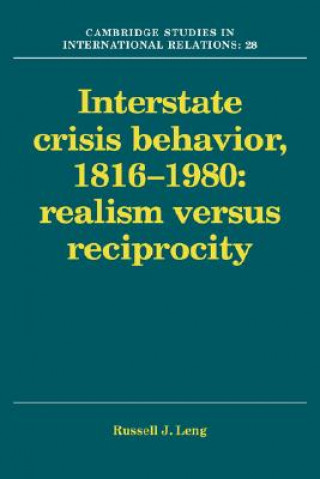
Interstate Crisis Behavior, 1816-1980
 Inglés
 373 b
373 b
Hasta 30 días para devoluciones
Clientes que también han comprado






 /
/
 Tapa blanda
 72.79
€
72.79
€

 binding.
104.39
€
binding.
104.39
€




 /
Tapa dura
40.71
€
/
Tapa dura
40.71
€


Why have some interstate crises escalated to war when other have not? Are there patterns of behavior that war-prone disputes share in common? These are some of the questions considered by Russell Leng as he examines the behavior of nations in forty militarised crises occurring between 1816 and 1980. Leng considers the conditions under which crises are more or less likely to escalate to war or be resolved peacefully and compares the descriptive and prescriptive validity of two competing perspectives on conflict behavior: classical realism and the psychological approaches of behavioral scientists. The author concludes that elements of both realist and psychological perspectives are necessary for an adequate understanding of interstate crisis behavior and that the most effective approach to crisis bargaining combines each perspective in a firm-but-flexible 'reciprocating' strategy. The epilogue presents a provocative critique of the bargaining strategies pursued by the United States and Iraq during the Gulf Crisis of 1990–1991.


Sobre el libro
Inglés

Regale este libro hoy
Es fácil
1 Añadir al carrito y elegir Entregar como regalo en el checkout 2 Le enviaremos un vale 3 El libro llegará a la dirección del destinatarioTambién puede interesarle
 /
Tapa blanda
10.09
€
/
Tapa blanda
10.09
€




 /
Tapa blanda
85.09
€
/
Tapa blanda
85.09
€



 /
Tapa blanda
37.71
€
/
Tapa blanda
37.71
€










 /
Tapa dura
301.69
€
/
Tapa dura
301.69
€

¡Hola! Soy Libroamiko, tu asesor de libros.
¿Cómo puedo ayudarte?