
 Contacto
 Cómo comprar
Entrega
Guía de compras
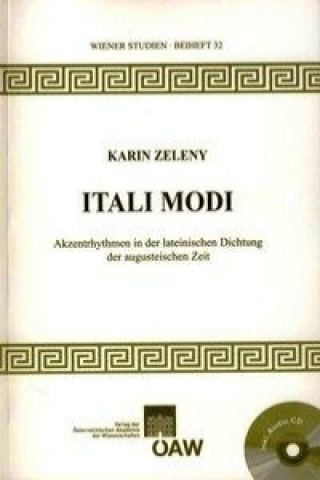
Itali Modi
 Alemán
 206 b
206 b
Hasta 30 días para devoluciones
Clientes que también han comprado

 /
/
 Tapa dura
 32.99
€
32.99
€














 /
Tapa blanda
23.89
€
/
Tapa blanda
23.89
€








Die hier erstmals vorgestellte These der Akzentrhythmen, laut der die normalen Wortakzente für die innere, rhythmische Struktur lateinischer Dichtung verantwortlich sind, öffnet einen völlig neuen Weg in der Metrik-Forschung, indem sie Verse vom musikologischen Standpunkt betrachtet. Antike Quellen überliefern, dass der Wortakzent, der laut heute praktisch allgemein anerkannten linguistischen Erkenntnissen dynamischer Natur war, in der lateinischen Sprache grundlegende Bedeutung hatte und dass lateinische Dichtung nicht so sehr für Leser als vielmehr für Hörer verfasst wurde. Bei der Analyse von Versen sind daher akustisch wahrnehmbare Faktoren von besonderem Interesse. Ein schlagendes Argument liefert die erhaltene Dichtung selbst. Regulierungen von Versklauseln und Caesuren wurden in der Forschung bereits vielfach beschrieben. Sie alle betreffen Wortgrenzen im Vers. Aber was war der Zweck dieser Regulierungen? Wenn sie nicht auf das Auge, sondern auf das Ohr wirken sollten, dann liegt die Annahme nahe, dass sie auf die regelmäßige Anordnung der hörbaren Wortakzente abzielten, die ja aufgrund der Paenultimaregel von den Wortenden abhängig sind. Die entstehenden Rhythmen sind allerdings für moderne abendländische Ohren ungewohnt, da sie nicht dem landläufigen Zweier- oder Dreiertakt-Schema entsprechen. Wenn man die langen und kurzen Silben im Verhältnis 2:1 liest und die Wortakzente im Vers als "Taktschlag" verwendet, ergeben sich additive Rhythmen (vergleichbar mit verwandten musikalischen Formen wie dem mitteleuropäischen Zwiefachen, den indischen Talas, westafrikanischen Timelines etc.), die gemäß den verschiedenen Wortgrenzen und -akzenten variabel sind (so hat etwa der durch Klausel und Caesuren regulierte Hexameter mit seinen 24 Zeiteinheiten nur drei rhythmische Grundformen). Diese Variabilität steht im Einklang mit dem antiken Rhythmusbegriff: Laut Quintilian 9,4,55 ist der Sprachrhythmus in Prosa und Vers (!) nie gleichförmig fortlaufend, weswegen jeglicher "Iktus" (die prinzipielle Betonung der ersten Silben der Versfüße, wobei die Wortakzente ignoriert werden; in der Schule dient er zur Unterscheidung von langen und kurzen Silben) beim normalen Verselesen abzulehnen ist. Das quantitierende Versfußsystem ist nur ein Raster, in den die Worte eingefügt werden, der aber selbst beim Vortrag nicht hörbar wird. Man kann es mit einem geknüpften Teppich vergleichen: Das Muster entsteht auf der Vorderseite, und die zugrundeliegende Struktur lässt sich auf der Rückseite noch erkennen. Wer "Ikten" liest, würde gleichsam den Teppich verkehrt auflegen. Eines der faszinierenden Ergebnisse dieser Studie ist, dass die Akzentrhythmen mit Inhalt und Form des Textes in Verbindung stehen; so signalisiert etwa Ovid Satzschlüsse innerhalb des Hexameters durch bestimmte Rhythmen, die damit die Funktion der modernen Satzzeichen erhalten. ... The thesis of accentual rhythm, presented in this study for the first time, according to which normal word accents are responsible for the inner rhythmical structure of Latin poetry, opens a completely new path in metrical research by examining verses from a musicological point of view. Ancient testimony proves that word accent (according to modern linguistics which are not seriously challenged nowadays it was a stress accent) is fundamental to the Latin language, and that Latin poetry was generally recited to listeners rather than written for readers. In verse-analysis acoustically perceptible factors therefore are of particular interest. An impressive argument is provided by the remaining poetry itself. Regulations of verse clausulae and caesurae have already been widely discussed in metrical research. They all concern word boundaries in the verse. But what was the purpose of those regulations? If they should act upon the ear rather than upon the eye, then it is safe to assume that they were aimed at the regular distribution of word accents, which according to the law of the penultimate depend on the word endings. The resulting rhythms however are unfamiliar to modern occidental ears, in that they do not correspond to the common scheme of two or three beats to the bar. If one recites the long and short syllables in the correct ratio of 2:1 and uses the word accents as "downbeats", the result thus derived is additive rhythms (comparable to the Central-European Zwiefacher, Indian Talas, West African Timeline-patterns, etc.), which are variable according to the variously located word boundaries and accents (e.g. the hexameter of 24 time units regulated by clausula and caesurae has only three main types with different basic timelines). This variability is consistent with ancient concepts of rhythm: according to Quintilian 9.4.55 the rhythm of Latin prose and verse (!) never runs on monotonously without variety, therefore any kind of "ictus" (the general stressing of first syllables of the verse foot, whereas word accents are ignored; in school it is useful to distinguish long from short syllables) in normal reciting of verses must be vehemently rejected. The quantitative system of verse feet is only a grid into which the words are inserted, but which in itself is not perceivable in reciting. It can be compared to a knotted carpet: The pattern is visible on the front side, and the underlying structure can still be seen on the back side. Anybody giving weight to the "ictus" would therefore be apt to display a carpet backwards. One of the fascinating results of this study is the fact that accentual rhythms are connected to the content and form of the text. Thus Ovid signals phrase endings inside the hexameter by certain rhythms, which take on the function of modern punctuation.


Sobre el libro
Alemán

Regale este libro hoy
Es fácil
1 Añadir al carrito y elegir Entregar como regalo en el checkout 2 Le enviaremos un vale 3 El libro llegará a la dirección del destinatarioTambién puede interesarle





 /
Tapa blanda
74.09
€
/
Tapa blanda
74.09
€



¡Hola! Soy Libroamiko, tu asesor de libros.
¿Cómo puedo ayudarte?