
 Contacto
 Cómo comprar
Entrega
Guía de compras
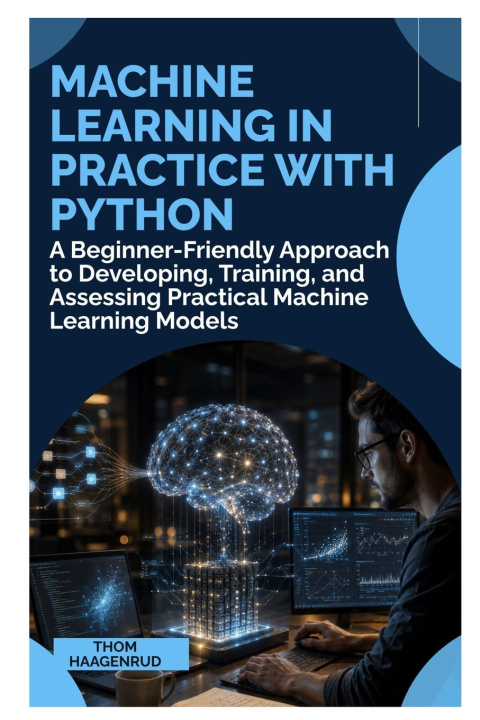
Machine Learning in Practice with Python
A Beginner-Friendly Approach to Developing, Training, and Assessing Practical Machine Learning Models
 Inglés
 47 b
47 b
 Nuevo
Nuevo
Hasta 30 días para devoluciones

Machine learning becomes much easier when you understand the complete process behind a trustworthy result.
Machine Learning in Practice with Python gives beginners a structured path from raw data and a clearly defined problem to an evaluated, interpreted, and reusable predictive solution.
Rather than overwhelming you with advanced mathematics or an endless collection of algorithms, this book focuses on the habits that matter in real projects. You will learn how to inspect information before using it, prepare features correctly, protect evaluation data, establish meaningful baselines, compare different approaches fairly, diagnose weak results, and improve your workflow using evidence instead of guesswork.
Inside, you will learn how to:
- Set up a clean Python environment for reproducible experiments
- Work confidently with NumPy, pandas, Matplotlib, JupyterLab, and scikit learn
- Load, inspect, filter, sort, group, and transform tabular datasets
- Identify missing values, duplicate records, suspicious entries, and potential outliers
- Separate identifiers from useful predictive variables
- Prepare numerical and categorical information correctly
- Create reliable train and test splits
- Recognize and prevent data leakage
- Encode categorical variables and scale numerical features
- Establish simple baselines before adding complexity
- Build and assess regression solutions
- Apply linear and regularized regression methods
- Build binary and multiclass classifiers
- Work with logistic regression and k nearest neighbors
- Understand confusion matrices, accuracy, precision, recall, and F1 score
- Build decision trees, random forests, and gradient boosting solutions
- Compare linear and tree based approaches
- Discover groups using K Means clustering
- Apply principal component analysis for dimensionality reduction
- Use cross validation for more reliable comparisons
- Perform grid search and randomized search efficiently
- Create reproducible preprocessing pipelines
- Engineer more informative features from domain knowledge
- Handle imbalanced classes with class weights and threshold adjustment
- Investigate variable importance and prediction errors
- Explain results without confusing correlation with causation
- Save complete fitted pipelines for later use
- Validate incoming records before prediction
- Record assumptions, limitations, dependencies, and metadata
- Understand basic monitoring and serialization security concerns
The final capstone combines the entire process into one complete project. You will define the objective, inspect and clean the dataset, create the preprocessing pipeline, establish a baseline, compare candidate approaches, use cross validation, tune the strongest candidate, examine errors, interpret results, test against protected data, save the finished pipeline, and create a reusable prediction workflow.
This book is designed for new Python learners, students, analysts, career switchers, developers, and working professionals who want a dependable introduction to applied predictive analytics. Advanced programming experience is not required, and neither calculus nor advanced linear algebra is necessary.
If you have seen tutorials that show you how to call fit() but leave you uncertain about what happens before and after that step, this book provides the missing structure.
Learn how to move from raw information to evidence, build results you can defend, and develop a repeatable workflow you can apply to your own projects.


Sobre el libro
Inglés

Regale este libro hoy
Es fácil
1 Añadir al carrito y elegir Entregar como regalo en el checkout 2 Le enviaremos un vale 3 El libro llegará a la dirección del destinatario¡Hola! Soy Libroamiko, tu asesor de libros.
¿Cómo puedo ayudarte?