
 Contacto
 Cómo comprar
Entrega
Guía de compras
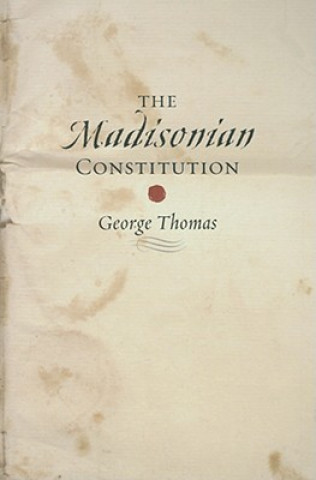
Madisonian Constitution
 Inglés
 158 b
158 b
Política de devolución de 30 días
Clientes que también han comprado



 /
/
 Tapa blanda
 10.09
€
10.09
€





















Today, we think of constitutional questions as being settled by the Supreme Court.But that is not always the case, nor is it what the framers intended in constructing the three-branch federal government. This volume examines four crucial moments in the United States' political history-the Civil War and Reconstruction, the Progressive Era, Franklin Delano Roosevelt's presidency and the New Deal, and the Reagan revolution-to illustrate the Madisonian view that the present rise of judicial supremacy actually runs counter to the Constitution as established at the nation's founding. George Thomas opens by discussing how the Constitution encourages an antagonistic approach to settling disputes, thereby preserving itself as the nation's fundamental law rather then ceding that role to the president, Congress, or Supreme Court. In considering the four historical case studies, he focuses on judicial interpretations and the political branches' responses to them to demonstrate that competing conceptions of constitutional authority and meaning, as well as intergovernmental disputes themselves-rather than any specific outcome-strengthen the nature of the nation's founding document as a political instrument. Engagingly written and soundly argued, this study clarifies and highlights the political origins of the nation's foundational document and argues that American constitutionalism is primarily about countervailing power not legal limits enforced by courts.


Sobre el libro
Inglés

Regale este libro hoy
Es fácil
1 Añadir al carrito y elegir Entregar como regalo en el checkout 2 Le enviaremos un vale 3 El libro llegará a la dirección del destinatarioTambién puede interesarle
 /
Tapa blanda
31.89
€
/
Tapa blanda
31.89
€





 /
Tapa blanda
13.09
€
/
Tapa blanda
13.09
€
 /
Tapa blanda
16.29
€
/
Tapa blanda
16.29
€

 /
Tapa blanda
11.19
€
/
Tapa blanda
11.19
€
 /
Tapa blanda
13.59
€
/
Tapa blanda
13.59
€
 /
Tapa blanda
19.89
€
/
Tapa blanda
19.89
€



 /
Tapa dura
9.19
€
/
Tapa dura
9.19
€
 /
Tapa blanda
18.09
€
/
Tapa blanda
18.09
€

 /
Tapa blanda
50.39
€
/
Tapa blanda
50.39
€






¡Hola! Soy Libroamiko, tu asesor de libros.
¿Cómo puedo ayudarte?