
 Contacto
 Cómo comprar
Entrega
Guía de compras
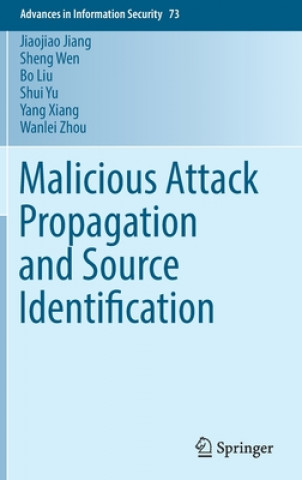
Malicious Attack Propagation and Source Identification
 Inglés
 367 b
367 b
Política de devolución de 30 días
Clientes que también han comprado

















This book covers and makes four major contributions: 1) analyzing and surveying the pros and cons of current approaches for identifying rumor sources on complex networks; 2) proposing a novel approach to identify rumor sources in time-varying networks; 3) developing a fast approach to identify multiple rumor sources; 4) proposing a community-based method to overcome the scalability issue in this research area. These contributions enable rumor source identification to be applied effectively in real-world networks, and eventually diminish rumor damages, which the authors rigorously illustrate in this book. In the modern world, the ubiquity of networks has made us vulnerable to various risks. For instance, viruses propagate throughout the Internet and infect millions of computers. Misinformation spreads incredibly fast in online social networks, such as Facebook and Twitter. Infectious diseases, such as SARS, H1N1 or Ebola, have spread geographically and killed hundreds of thousands people. In essence, all of these situations can be modeled as a rumor spreading through a network , where the goal is to find the source of the rumor so as to control and prevent network risks. So far, extensive work has been done to develop new approaches to effectively identify rumor sources. However, current approaches still suffer from critical weaknesses. The most serious one is the complex spatiotemporal diffusion process of rumors in time-varying networks, which is the bottleneck of current approaches. The second problem lies in the expensively computational complexity of identifying multiple rumor sources. The third important issue is the huge scale of the underlying networks, which makes it difficult to develop efficient strategies to quickly and accurately identify rumor sources. These weaknesses prevent rumor source identification from being applied in a broader range of real-world applications. This book aims to analyze and address these issues to make rumor source identification more effective and applicable in the real world. The authors propose a novel reverse dissemination strategy to narrow down the scale of suspicious sources, which dramatically promotes the efficiency of their method. The authors then develop a Maximum-likelihood estimator, which can pin point the true source from the suspects with high accuracy. For the scalability issue in rumor source identification, the authors explore sensor techniques and develop a community structure based method. Then the authors take the advantage of the linear correlation between rumor spreading time and infection distance, and develop a fast method to locate the rumor diffusion source. Theoretical analysis proves the efficiency of the proposed method, and the experiment results verify the significant advantages of the proposed method in large-scale networks. This book targets graduate and post-graduate students studying computer science and networking. Researchers and professionals working in network security, propagation models and other related topics, will also be interested in this book.


Sobre el libro
Inglés

Regale este libro hoy
Es fácil
1 Añadir al carrito y elegir Entregar como regalo en el checkout 2 Le enviaremos un vale 3 El libro llegará a la dirección del destinatarioTambién puede interesarle




 /
/
 Tapa dura
 151.59
€
151.59
€
 /
Tapa blanda
12.19
€
/
Tapa blanda
12.19
€


 /
Tapa blanda
7.99
€
/
Tapa blanda
7.99
€

 /
Tapa blanda
7.99
€
/
Tapa blanda
7.99
€







¡Hola! Soy Libroamiko, tu asesor de libros.
¿Cómo puedo ayudarte?