Contacto
 Cómo comprar
Entrega
Guía de compras
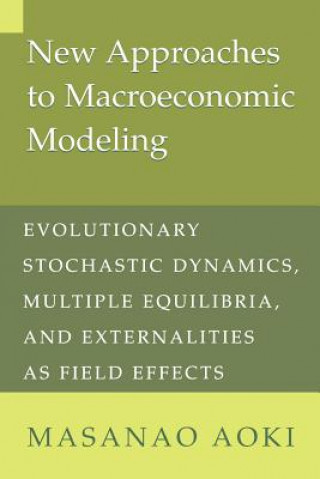
New Approaches to Macroeconomic Modeling
 Inglés
 154 b
154 b
Hasta 30 días para devoluciones
Clientes que también han comprado









 /
/
 Tapa blanda
 15.29
€
15.29
€







 /
Tapa blanda
49.29
€
/
Tapa blanda
49.29
€

This book contributes substantively to state-of-the-art macroeconomic modeling by providing a method for modeling large collections of heterogeneous agents subject to non-pairwise externality called field effects, i.e. feedback of aggregate effects on individual agents or agents using state-dependent strategies. Adopting a level of microeconomic description which keeps track of compositions of fractions of agents by 'types' or 'strategies', time evolution of the microeconomic states is described by (backward) Chapman-Kolmogorov equations. Macroeconomic dynamics naturally arise by expansion of the solution in some power series of the number of participants. Specification of the microeconomic transition rates thus leads to macroeconomic dynamic models. This approach provides a consistent way for dealing with multiple equilibria of macroeconomic dynamics by ergodic decomposition and associated calculations of mean first passage times, and stationary probabilities of equilibria further provide useful information on macroeconomic behavior.


Sobre el libro
Inglés

Regale este libro hoy
Es fácil
1 Añadir al carrito y elegir Entregar como regalo en el checkout 2 Le enviaremos un vale 3 El libro llegará a la dirección del destinatarioTambién puede interesarle

 /
Tapa blanda
27.89
€
/
Tapa blanda
27.89
€








 /
Tapa blanda
21.59
€
/
Tapa blanda
21.59
€

 /
Tapa blanda
49.99
€
/
Tapa blanda
49.99
€