
 Contacto
 Cómo comprar
Entrega
Guía de compras
 Inglés
 45 b
45 b
 Próximamente
 Nuevo
Nuevo
 Lanzamiento 18. 05. 2027
Hasta 30 días para devoluciones

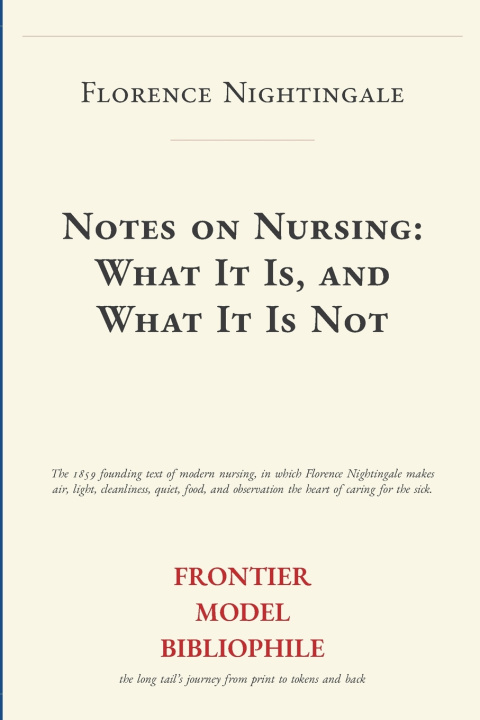
In 1859 Florence Nightingale, fresh from the carnage of the Crimean War, wrote a short book for the ordinary woman who would one day nurse a member of her own household. Its claim was radical and simple: recovery depends less on medicine than on air, light, warmth, cleanliness, quiet, food, and the trained habit of observation. Written before germ theory, it founded modern nursing anyway. Reproduced from the 1859 London Harrison first edition.
Notes on Nursing appeared in 1859, at the meeting point of three movements that defined mid-Victorian medicine: the sanitary reform of the cities, the reckoning that followed the Crimean War, and the slow professionalization of nursing. To read the book historically is to read it as the distillation of all three.
The first context is the sanitary movement. The industrial cities of early-Victorian Britain were lethally unhealthy. Cholera epidemics in 1831-32, 1848-49, and 1853-54 killed tens of thousands; typhus and typhoid were endemic; infant mortality was staggering. Edwin Chadwick's Report on the Sanitary Condition of the Labouring Population (1842) had argued that filth, bad drainage, foul air, and overcrowding caused disease, and that cleaning the environment would save lives. The dominant explanatory framework was the miasma theory: the belief that disease arose from "bad air" - noxious vapors rising from decaying matter, sewage, and stagnant water. Nightingale was a wholehearted miasmatist. She did not accept the rival contagion theory, and she did not live to embrace the germ theory that would supersede both. Her entire argument in Notes on Nursing rests on the conviction that if you supply pure air, pure water, drainage, cleanliness, and light, disease will largely disappear. The theory was wrong; the practice was very nearly right, because the conditions that breed miasmatic fear - filth, stagnation, and crowding - are also the conditions that breed and spread pathogens.
The second context is the Crimean War (1853-56) and the statistical campaign that followed it. Nightingale's experience at Scutari convinced her that the British soldier was being killed not by the enemy but by his own army's neglect of sanitation. After the war she gathered and analyzed mortality data with a rigor that was, for its day, extraordinary, and she invented memorable ways to display it. Her polar-area diagrams - wedge charts in which the area of each segment represents the deaths in a month, color-coded to separate deaths from preventable disease, from wounds, and from other causes - made the argument visible to ministers who would never read a table. They are among the founding documents of statistical graphics, and they belong to the same intellectual project as Notes on Nursing: the insistence that health is measurable, that mortality is mostly preventable, and that the prevention lies in environment and management rather than in the heroics of medicine. The mortality diagram retained in this edition is a direct artifact of that campaign.
The third context is nursing itself. Before Nightingale, hospital nursing in Britain was largely unskilled, untrained, and disreputable, a trade for women who could find no better employment; Dickens's gin-soaked Sarah Gamp was a recognizable caricature. There was no system of training, no professional standing, and no body of agreed practice. Nightingale's purpose was to change this, and Notes on Nursing was an opening move.


Sobre el libro
Inglés

Regale este libro hoy
Es fácil
1 Añadir al carrito y elegir Entregar como regalo en el checkout 2 Le enviaremos un vale 3 El libro llegará a la dirección del destinatario¡Hola! Soy Libroamiko, tu asesor de libros.
¿Cómo puedo ayudarte?