
 Contacto
 Cómo comprar

Entrega
Guía de compras
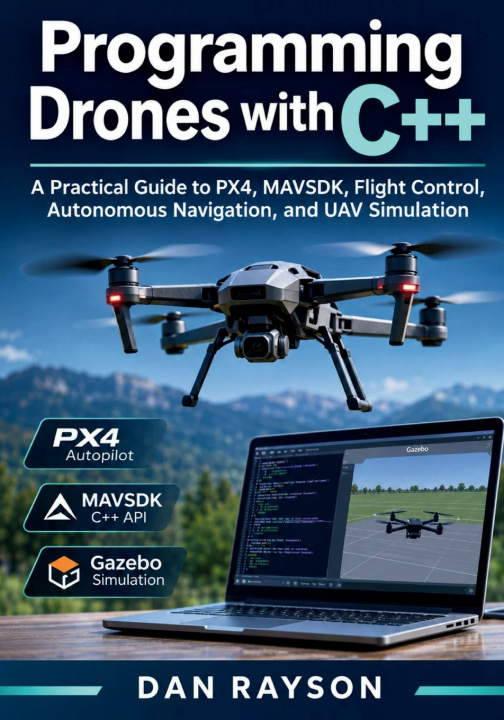
Programming Drones with C++
A Practical Guide to PX4, MAVSDK, Flight Control, Autonomous Navigation, and UAV Simulation.
 Inglés
 62 b
 Nuevo
 Entrega en Navidad ▾
Almacenamiento externo
Envío en 9-13 días
Hasta 30 días para devoluciones

Build, program, and simulate autonomous drones using modern C++, PX4, MAVSDK, and Gazebo.
Drone programming involves far more than sending takeoff commands. Reliable autonomous flight requires an understanding of vehicle communication, telemetry, flight control, navigation, safety constraints, and the software architecture connecting these components.
Programming Drones with C++ provides a practical, technically detailed guide to developing UAV applications with C++17, the PX4 autopilot, MAVSDK, MAVLink, and Gazebo simulation.
Written for software developers, robotics programmers, engineering students, and UAV enthusiasts with programming experience, this book explains how autonomous drone applications operate, how their components communicate, and how to design software that responds reliably to changing vehicle conditions.
What You Will LearnDrone Software Architecture: Understand flight controllers, companion computers, PX4 modules, MAVLink communication, and the responsibilities of each system component.
C++ Development Environment: Configure modern C++, CMake, PX4 Software-in-the-Loop, MAVSDK, and Gazebo for practical drone development.
Telemetry and Vehicle Monitoring: Read position, altitude, attitude, velocity, battery information, and vehicle health using MAVSDK C++.
Flight Operations: Program arming, takeoff, landing, hold, and return commands while handling command failures and vehicle state changes.
Autonomous Missions: Develop waypoint navigation, mission execution, progress monitoring, geofencing, and application-level safety policies.
Offboard Flight Control: Understand position and velocity setpoints, coordinate frames, continuous control requirements, and failsafe behavior.
Sensors and Navigation: Learn how inertial sensors, GNSS, state estimation, feedback control, and navigation logic contribute to autonomous operation.
Simulation and Testing: Use PX4 and Gazebo to examine vehicle behavior, diagnose communication problems, simulate failures, and evaluate application reliability.
Software Engineering Practices: Structure C++ applications with modular components, asynchronous operations, logging, error handling, and automated testing.
Throughout the book, practical programming examples demonstrate how to connect to a simulated quadcopter, monitor its state, execute flight commands, manage autonomous missions, and implement safety-conscious application logic.
The capstone project brings these concepts together into an integrated C++ mission application, supported by guidance on system architecture, build configuration, testing, diagnostics, and deployment considerations.
Who This Book Is ForThis book is suitable for intermediate C++ programmers, robotics developers, UAV software engineers, embedded systems programmers, and engineering students who want to develop a deeper understanding of practical drone software.
Prior drone programming experience is not required, although familiarity with C++, object-oriented programming, and basic development tools is recommended.
Move beyond basic drone operation and develop the software skills needed to build, simulate, and evaluate autonomous UAV applications.


Sobre el libro
Inglés

Regale este libro hoy
Es fácil
1 Añadir al carrito y elegir Entregar como regalo en el checkout 2 Le enviaremos un vale 3 El libro llegará a la dirección del destinatario¡Hola! Soy Libroamiko, tu asesor de libros.
¿Cómo puedo ayudarte?