Contacto
 Cómo comprar
Entrega
Guía de compras
 Inglés
 373 b
373 b
Hasta 30 días para devoluciones
Clientes que también han comprado














 /
/
 Tapa blanda
 17.09
€
17.09
€







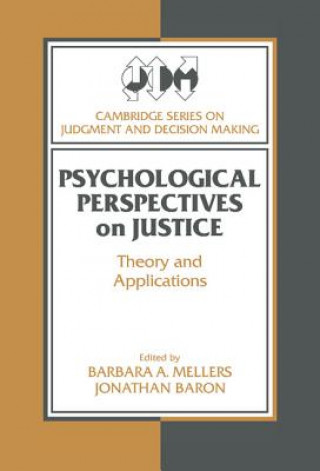
Justice, equity, and fairness are central concerns of everyday life, whether we are assessing the fairness of individual acts, social programmes, or institutional policies. This book explores how the distribution of costs and benefits determine our intuition about fairness and why individual behaviour sometimes deviates from normative theories of justice. To make any comparison, one must first state how fair distributions of resources or burdens should be made. Here, competing theories, such as utilitarianism and economic efficiency, are discussed. The chapters cover many topics including an investigation of various rules and heuristics that people use to make fair distributions; the motivation for people to conform to rules of fairness even when they conflict with self-interest; differences between the views of liberals and conservatives; societal rules for the distribution or allocation of critical or scarce resources; and implications for public policy. This mixture of theoretical and applied perspectives provides a balanced look at the psychology of justice.


Sobre el libro
Inglés

Regale este libro hoy
Es fácil
1 Añadir al carrito y elegir Entregar como regalo en el checkout 2 Le enviaremos un vale 3 El libro llegará a la dirección del destinatarioTambién puede interesarle







 /
Tapa blanda
10.69
€
/
Tapa blanda
10.69
€


 /
Tapa dura
112.79
€
/
Tapa dura
112.79
€



 /
Tapa dura
83.99
€
/
Tapa dura
83.99
€
 /
Tapa blanda
12.89
€
/
Tapa blanda
12.89
€