
 Contacto
 Cómo comprar
Entrega
Guía de compras
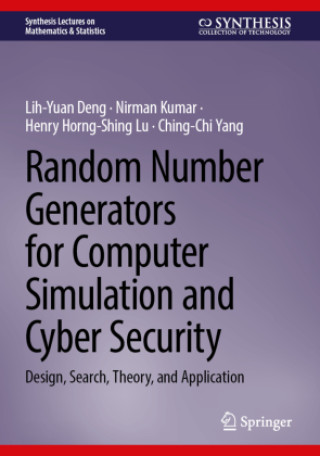
Random Number Generators for Computer Simulation and Cyber Security
Design, Search, Theory, and Application
 Inglés
 122 b
122 b
Hasta 30 días para devoluciones
Clientes que también han comprado



 /
/
 Tapa blanda
 45.09
€
45.09
€
 /
Tapa blanda
48.79
€
/
Tapa blanda
48.79
€




 /
Tapa dura
18.99
€
/
Tapa dura
18.99
€






 /
Tapa blanda
15.39
€
/
Tapa blanda
15.39
€







 /
Tapa blanda
19.99
€
/
Tapa blanda
19.99
€





This book discusses the theory and practice of random number generators that are useful for computer simulation and computer security applications. Random numbers are ubiquitous in computation. They are used in randomized algorithms to perform sampling or choose randomly initialized parameters or perform Markov Chain Monte Carlo (MCMC). They are also used in computer security applications for various purposes such as cryptographic nuances or in authenticators. In practice, the random numbers used by any of these applications are from a pseudo-random sequence. These pseudo-random sequences are generated by RNGs (random number generators). This book discusses the theory underlying such RNGs, which are used by all programmers. However, few try to understand the theory behind them. This topic is an active area of research, particularly when the generators are used for cryptographic applications. The authors introduce readers to RNGs, how they are judged for quality, the mathematical and statistical theory behind them, as well as provide details on how these can be implemented in any programming language. The book discusses non-linear transformations that use classical linear generators for cryptographic applications and how to optimize to make such generators more efficient. In addition, the book provides up-to-date research on RNGs including a modern class of efficient RNGs and shows how to search for new RNGs with good quality and how to parallelize these RNGs.


Sobre el libro
Inglés
Categorías

Regale este libro hoy
Es fácil
1 Añadir al carrito y elegir Entregar como regalo en el checkout 2 Le enviaremos un vale 3 El libro llegará a la dirección del destinatarioTambién puede interesarle













 /
Tapa blanda
24.29
€
/
Tapa blanda
24.29
€
 /
Tapa blanda
63.69
€
/
Tapa blanda
63.69
€








 /
Tapa blanda
46.49
€
/
Tapa blanda
46.49
€
¡Hola! Soy Libroamiko, tu asesor de libros.
¿Cómo puedo ayudarte?