
 Contacto
 Cómo comprar
Entrega
Guía de compras
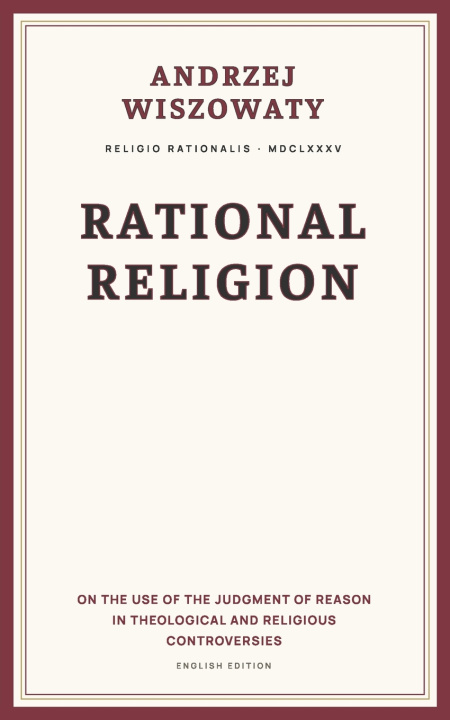
Rational Religion
On the Use of the Judgment of Reason in Theological and Religious Controversies
 Inglés
 52 b
52 b
 Nuevo
Nuevo
Hasta 30 días para devoluciones

Who decides what is true in matters of faith?
Every party to the confessional quarrels of the seventeenth century appealed to the same Holy Scripture - and each arrived at doctrines contradicting the others. Three answers were on offer: the authority of the Church, the inward testimony of the Spirit, and the judgment of reason.
Andrzej Wiszowaty shows that the first two cannot do without the third. Whoever appeals to the Church must give reasons for which church is the true one. Whoever appeals to the Spirit must be able to tell which spirit is from God. In both cases reason ends up judging after all - only without admitting it.
From this follows the thesis that gave the treatise its name: religion is rational. Revelation may go beyond reason - it can disclose what no one would have arrived at unaided. But it cannot contradict reason, for the same God who reveals also gave reason. Where an interpretation leads into absurdity, it is not reason that must be dismissed, but the interpretation that must be examined.
The practical edge of the argument appears in Wiszowaty's opening paragraph: once men have grown accustomed to believing against reason, they grow accustomed to acting against reason in other matters as well - and the persecution of dissenters is the foreseeable consequence. He knew whereof he wrote. His church, the Polish Brethren, was banished from Poland by decree of the Diet in 1658; he composed this treatise as an exile.
The case is made by distinctions rather than by abuse: between what lies above reason and what runs counter to it; between the rule by which judgment is passed and the judge who passes it; between what Scripture says and what one reads into it.
From the contents
- Rule or judge: why Scripture remains the supreme norm and yet someone must apply it
- Seventeen proofs for the use of reason in matters of faith
- An eighteenth proof from testimony: the ancient Church, Roman controversialists such as Bellarmine, Lutheran and Reformed teachers - and even the Enthusiasts and the Quakers
- Fourteen objections and their solution: original sin, the sublimity of the mysteries, the miracles, "with God all things are possible", bringing the understanding into captivity to the obedience of faith, "so many heads, so many opinions"
About this edition
Translated from the Latin original printing Religio Rationalis, seu De Rationis Judicio, in Controversiis etiam Theologicis ac religiosis, adhibendo, with explanatory footnotes on persons, works and presupposed terms, and a glossary of terms. The original runs on almost without division and carries one heading of its own; all others were added for readability. The division follows the German edition, so the two can be compared chapter by chapter.
Andrzej Wiszowaty (Latinized Andreas Wissowatius, 1608-1678) was a grandson of Faustus Socinus and a leading theologian of the Polish Brethren. After the expulsion of the Antitrinitarians from Poland he lived in exile, latterly in Amsterdam. His treatise stands on a threshold: still wholly within the world of confessional polemic, it already formulates that claim to the independent use of reason which a century later became the hallmark of the Enlightenment. Whoever wishes to understand how religious toleration grew out of theological controversy will find here one of its earliest and clearest testimonies.
The book invites contradiction, and its author would have wanted nothing else. Its real thesis is not that reason is right, but that no one may exempt himself from examination - least of all where he appeals to God.
For readers who would rather think for themselves than have their thinking done for them.


Sobre el libro
Inglés

Regale este libro hoy
Es fácil
1 Añadir al carrito y elegir Entregar como regalo en el checkout 2 Le enviaremos un vale 3 El libro llegará a la dirección del destinatario¡Hola! Soy Libroamiko, tu asesor de libros.
¿Cómo puedo ayudarte?